
BIM (Building Information Modeling) is a digital process of creating intelligent 3D models embedded with data for design, construction, and facility management.
If you’ve seen BIM referenced in an RFP, a GSA contract clause, or a project kickoff meeting and want a straight answer, you’re in the right place. Most owners and general contractors now budget for BIM services the same way they budget for structural engineering or MEP design, so understanding what you’re actually paying for matters.
This guide breaks down what Building Information Modeling actually is, how it works on construction projects, which U.S. regulations require it, and — just as importantly — where BIM is heading in 2026 with AI, digital twins, and cloud-first workflows. Let’s get into it.
What is BIM, actually?
BIM (Building Information Modeling) is a collaborative process for creating and managing a data-rich, intelligent 3D model that represents the physical and functional characteristics of a building or infrastructure asset across its entire lifecycle. According to the National BIM Standard-United States (NBIMS-US), maintained by the National Institute of Building Sciences (NIBS), BIM is defined as a digital representation of the physical and functional characteristics of a facility.
In practice, that means every wall, duct, and beam in the model isn’t just a shape — it carries data about material, cost, schedule, and performance. Consequently, architects, engineers, contractors, and owners all work from one shared source of truth instead of dozens of disconnected drawings. Simply put, BIM is a process, not a single software product.
BIM Vs Traditional CAD: What is the Difference Between the Two?
The core difference is that CAD produces static drawings, while BIM produces a connected, data-rich model that updates automatically the moment any part of it changes. In other words, CAD tells you what something looks like; BIM tells you what something is. Here is the table showing CAD Vs BIM.
| Aspect | CAD | BIM |
| Geometry & Data | 2D or 3D geometry with no embedded data; changes have to be updated manually across every drawing sheet. | Intelligent objects — walls, pipes, columns — carry properties like cost, manufacturer, and performance; a single change propagates everywhere automatically. |
| Discipline Coordination | Disciplines typically work in silos and reconcile drawings at review meetings. | Disciplines coordinate inside one shared model, catching conflicts long before they reach the field. |
As a result, teams using BIM generally spend less time reconciling drawings and more time solving actual design and constructability problems.
What Are the Dimensions (3D to 8D) in BIM?
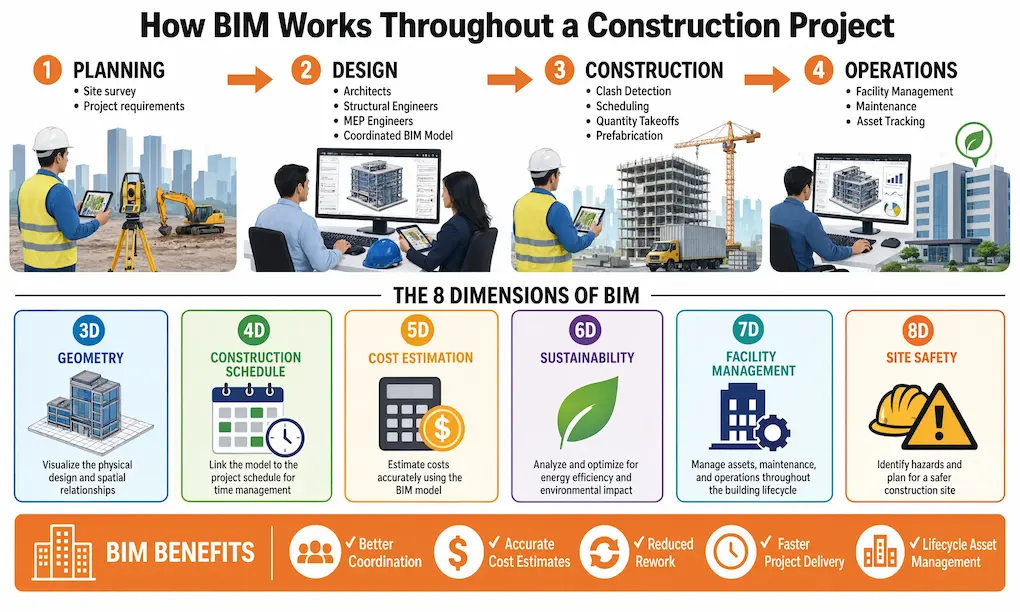
BIM “dimensions” describe the layers of information added on top of the base 3D model. Together, they turn a static model into a full project-management tool. Here’s the breakdown every construction professional should know:
| Dimension | Focus | Description |
| 3D | Geometry | The visual, spatial model of the asset |
| 4D | Time | Links the model to the construction schedule so teams can simulate sequencing before breaking ground |
| 5D | Cost | Ties quantities in the model to cost estimates, so budgets update automatically as the design evolves |
| 6D | Sustainability | Adds energy performance and environmental data directly into the model |
| 7D | Facility Management | Extends the model into operations, supporting maintenance, warranties, and asset tracking after handover |
| 8D | Safety | An emerging layer that flags site-safety risks during design and planning, before a single worker sets foot on site |
That said, the industry doesn’t apply these labels with perfect consistency — some frameworks combine or reorder them — so it’s best to treat “dimensions” as a mental model for what data BIM can carry, rather than a rigid, universally standardized system.
BIM Levels of Maturity: What Does Each Mean, from Level 0 to Level 3?
BIM maturity levels describe how collaboratively a project team actually works, ranging from Level 0 (paper-based, zero collaboration) to Level 3 (a single, shared model accessed by every discipline). Here’s the quick version:
● Level 0 — 2D CAD
Level 0 represents the most basic stage of digital construction documentation, relying entirely on 2D CAD drawings distributed as paper printouts or PDF files. There is no real collaboration between disciplines at this stage; each team produces and shares static drawings independently. Coordination happens manually, often through physical meetings, making this level prone to errors, miscommunication, and duplicated effort across project stakeholders.
● Level 1 — Mixed 2D and 3D
At Level 1, projects begin incorporating a mix of 2D and 3D CAD tools, though each party still manages its own data separately without a unified system. There may be some basic use of a shared common data environment (CDE) for document management, but true model-based collaboration is absent. Disciplines work in isolation, and information exchange remains fragmented, limiting the ability to detect conflicts early in the design process.
● Level 2 — Collaborative 3D Modeling
Level 2 marks a significant shift, where every discipline builds its own dedicated 3D model rather than relying solely on 2D drawings. Teams exchange data through open, standardized formats such as IFC, enabling federated model coordination. While each party still owns and maintains its individual model, this interoperability allows for clash detection and improved collaboration, making Level 2 the current mainstream standard for most BIM-driven construction projects.
● Level 3 — Open BIM
Level 3 represents the most advanced and integrated stage, where all disciplines access and edit one shared, cloud-hosted model in real time. Often referred to as Open BIM, this approach eliminates data silos, enabling true collaborative authoring across architecture, engineering, and construction teams. This level supports full lifecycle integration, from design through facility management, though it remains less common due to technological, contractual, and organizational challenges.
Quick Snapshot of All Levels:
| Maturity Level | Name | Description |
| Level 0 | 2D CAD | Paper or PDF-based, no real collaboration |
| Level 1 | Mixed 2D and 3D | Mixed 2D and 3D, but each party manages its own data separately |
| Level 2 | Collaborative 3D Modeling | Every discipline builds its own 3D model, and teams exchange data through open, common formats |
| Level 3 | Open BIM | One shared, cloud-hosted model that every discipline accesses and edits together, often called Open BIM |
However, the “Levels 0–3” language has largely been superseded internationally by ISO 19650, the international standard that governs managing information over the whole lifecycle of a built asset using BIM. Published in five parts covering concepts and principles, the delivery phase, the operational phase, information exchange, and security, ISO 19650 is now the reference point most U.S. firms bidding on federal or multinational projects should actually align with, rather than the older, UK-originated levels framework.
Note: If your firm bids on federal or international work, it’s worth reviewing ISO 19650 directly instead of relying on the older “BIM Levels” terminology, since procurement language increasingly references the ISO standard by name.
What is BIM Workflow?
BIM isn’t a one-time deliverable — it’s a continuous workflow that follows the asset from first sketch all the way to demolition. Here’s what that looks like in practice:
- Planning: Teams capture existing site conditions and lock in project requirements inside the model.
- Design: Architects and engineers build discipline-specific models, often leaning on dedicated BIM modeling services to turn design intent into coordinated geometry, then merge them for review.
- Construction: Contractors use the coordinated model — refined through ongoing BIM coordination services — for clash detection, sequencing, and off-site fabrication.
- Operations: Owners and facility managers inherit the model as a living asset database for maintenance, renovations, and future retrofits.
Because each phase directly feeds the next, errors caught early in design rarely make it all the way to the job site — and that’s exactly where most of BIM’s cost savings actually come from.
What Is a Common Data Environment (CDE) in BIM?
A Common Data Environment (CDE) is the single, centralized platform where every project stakeholder stores, accesses, and updates project data, so no one is ever working off an outdated file. Without one, teams fall back on email attachments and shared drives, and that’s precisely the kind of fragmentation that costs the industry real money.
In fact, the National Institute of Standards and Technology (NIST) found that inadequate interoperability — the inability to exchange data smoothly between systems — cost the U.S. capital facilities industry an estimated $15.8 billion annually, with owners and operators absorbing roughly two-thirds of that burden. A well-run CDE directly targets that exact problem by maintaining one authoritative dataset instead of dozens of disconnected copies scattered across inboxes — it’s what makes a reliable BIM coordination workflow possible in the first place.
Suggestion: When evaluating a CDE, prioritize open, vendor-neutral data formats — like Industry Foundation Classes (IFC), the open standard maintained by buildingSMART International — over proprietary lock-in. It protects your project data if your firm ever changes software down the road.
How Does BIM Benefit Construction Professionals?
BIM’s biggest benefits are fewer costly errors, faster schedules, and measurably higher productivity.
● Fewer Clashes and Rework
This is central to how BIM reduces costly errors — coordinating MEP, structural, and architectural models before construction catches conflicts on-screen instead of on-site. Identifying these issues digitally, rather than during physical construction, saves significant time, materials, and labor costs across the entire project lifecycle.
● Better Cost Control
Linking quantities directly to the model reduces estimating errors and last-minute change orders. As design changes occur, cost estimates update automatically in real time, giving project stakeholders accurate budget visibility throughout development and helping avoid unpleasant financial surprises during construction phases.
Build BIM smarter—get expert modeling support today.
Contact Us● Faster, More Predictable Scheduling
4D sequencing surfaces logistics problems before they cause actual delays. By simulating construction sequencing digitally, teams can identify scheduling conflicts, resource bottlenecks, and site logistics issues early, allowing for proactive adjustments that keep projects running on time and within planned timelines.
● Documented Productivity Gains
According to the McKinsey Global Institute, digital transformation initiatives — including BIM adoption — can drive productivity gains of 14–15% and cost reductions of 4–6% on construction projects. These figures demonstrate BIM’s tangible financial impact beyond theoretical efficiency claims.
● A Productivity Gap Worth Closing
That same research (McKinsey Global Institute) found global construction labor productivity grew only about 1% annually over two decades, compared with 2.8% for the broader economy, representing an estimated $1.6 trillion in unrealized annual value. BIM adoption directly addresses this substantial, industry-wide productivity shortfall.
Simply put, the data makes it clear that BIM isn’t optional anymore for firms trying to stay competitive on cost and schedule.
How is BIM Transforming the Future of Construction?
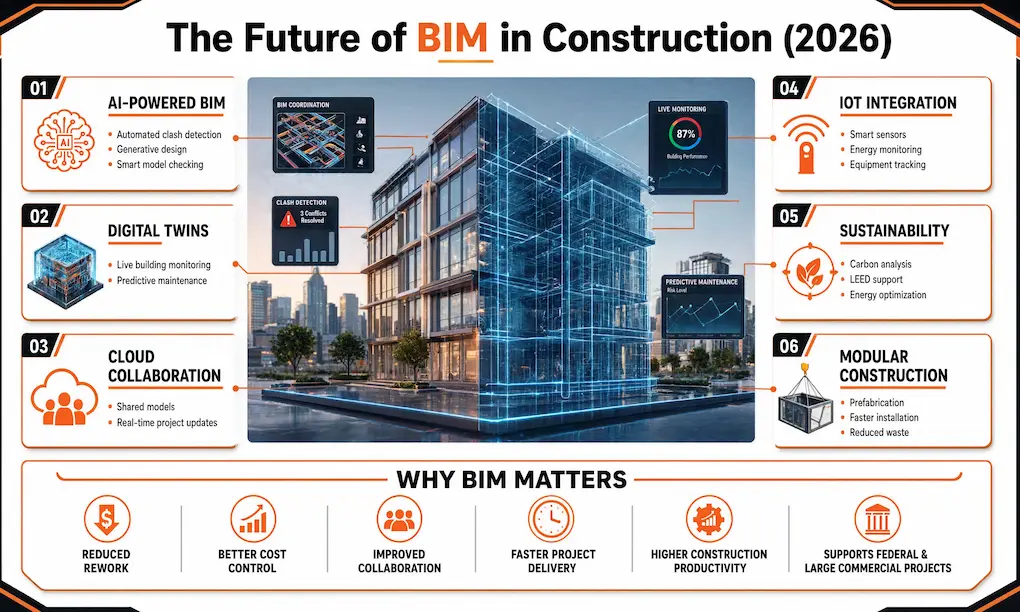
By combining AI, digital twins, cloud collaboration, sustainability tracking, IoT, continuous reality capture, modular construction methods, and GIS, BIM is transforming construction.
How Is Artificial Intelligence Changing BIM?
Artificial intelligence (AI) is now automating the most time-consuming parts of BIM — model quality checks, clash review, and early design generation — cutting hours of manual work down to minutes.
● Automated Clash Detection
AI flags coordination conflicts across disciplines without a human manually scrubbing every intersection point. By continuously scanning federated models, AI systems identify potential clashes in real time, allowing teams to resolve issues faster and focus their attention on genuinely complex coordination problems.
● Generative Design Assistance
AI proposes multiple layout or structural options based on the constraints a team sets, instead of producing just one solution to react to. This shifts the design process from evaluating a single proposal to comparing several viable alternatives, helping teams find more optimal solutions faster.
● Natural-Language Model Queries
Team members can ask questions about the model directly — for instance, how many fire-rated doors sit on level three — instead of manually filtering schedules by hand. This makes model data instantly accessible to non-technical stakeholders, speeding up decisions.
Meanwhile, this shift is quietly changing who does what on a project team. BIM coordinators increasingly focus on reviewing the exceptions’ AI flags, rather than checking every single element manually from scratch.
What Role Do Digital Twins Play in BIM?
A digital twin is a live, continuously updated digital replica of a physical asset, fed by real-world sensor data, which makes it fundamentally different from a static as-built BIM model. Where a traditional BIM model is essentially finalized at handover, a digital twin keeps evolving throughout the building’s entire operational life, pulling in data from building sensors to track real-world performance as it happens.
As a result, facility managers can now simulate scenarios — like equipment failure or a sudden change in occupancy load — against the live twin before making any physical changes at all. This is especially valuable for hospitals, airports, and other complex, safety-critical assets where unplanned downtime is extremely expensive.
Why Is Cloud Collaboration Now the Default, Not a Bonus Feature in BIM?
Cloud-based BIM collaboration has moved from a competitive advantage to a baseline expectation on nearly every multi-firm project. Because teams are increasingly distributed across offices, subcontractors, and time zones, real-time access to a shared, cloud-hosted model eliminates the version-control chaos that comes with emailing files back and forth all day.
On top of that, cloud-first workflows make it far easier to keep the CDE genuinely current, which, as covered above, ties directly back to reducing rework and interoperability losses on the job site.
How Is Sustainability Reshaping BIM Workflows?
Sustainability tracking inside BIM has expanded well beyond basic energy modeling to include whole-life carbon accounting tied directly to green-building certifications. Instead of estimating a building’s environmental footprint after construction wraps up, teams now model embodied carbon — the emissions locked into materials and the construction process itself — alongside operational energy use, starting from the earliest design stages.
Subsequently, this data feeds directly into certification pathways like LEED and other green-building rating systems, giving owners a documented carbon trail instead of a rough, after-the-fact estimate.
How Is IoT Integration Feeding Real-Time Data Into BIM?
Sensors embedded in building systems now feed live performance data directly back into the model in real time, covering HVAC performance, energy consumption, occupancy patterns, and equipment health. The model no longer represents a static snapshot frozen at handover, but stays connected to what’s actually happening inside the building day to day.
This shift changes how maintenance decisions get made. Rather than relying on fixed schedules, IoT-fed models support condition-based maintenance, flagging drift before it becomes a costly breakdown, while building a performance history that guides long-term capital planning.
Why Are Teams Moving Toward Continuous Reality Capture?
Instead of one scan-to-BIM pass at project start, teams increasingly run repeat laser scans and drone surveys throughout construction to validate the model against as-built conditions continuously. This catches discrepancies early, before they compound into costly problems that are far more expensive to fix once walls are closed.
Falling scanning costs now make repeat capture practical even on mid-sized projects. Teams gain an ongoing feedback loop between design intent and reality, reducing field disputes and boosting confidence in final as-built documentation.
How Does BIM Support Offsite and Modular Construction?
Prefabrication depends on precise BIM data to manufacture components off-site, then assemble them with tight tolerances once they arrive on-site. Because modular elements are built in a factory setting, even small dimensional errors can cascade into components that don’t fit together during final assembly.
As a result, modular workflows push BIM teams toward higher model precision and earlier coordination than stick-built construction demands, accelerating adoption of standardized component libraries and manufacturer-specific object data ahead of schedule.
What Does GIS Convergence Mean for Large-Scale Projects?
Building models increasingly connect to geospatial data, supporting infrastructure and smart-city-scale projects that span well beyond a single site boundary. This convergence lets teams coordinate across entire districts, utility networks, or transportation corridors rather than treating each structure as an isolated design problem.
For municipal projects especially, linking BIM to GIS means design decisions can account for underground utilities, environmental constraints, and regional planning data from the outset — increasingly essential as smart-city initiatives demand that buildings and infrastructure share data seamlessly across systems.
Why Is There a Need to Adopt BIM?
Federal agencies have required BIM on government-funded construction since 2003, and that requirement has only expanded since then. The General Services Administration (GSA) launched its National 3D-4D-BIM Program that year and now requires model-based deliverables — frequently referencing NBIMS-US, IFC, and COBie data formats — on its capital projects nationwide. Other federal bodies, including the U.S. Army Corps of Engineers (USACE) and the Department of Veterans Affairs (VA), maintain their own parallel BIM requirements for design and construction contracts.
That said, there’s no single nationwide BIM mandate the way some other countries have implemented one; U.S. requirements instead show up agency by agency, project by project, embedded directly into contract specifications and BIM execution plans.
Note: Always check the specific BIM Execution Plan (BEP) requirements written into the solicitation itself. Assuming “standard” GSA or state DOT requirements apply, without actually reading the contract, is a common — and costly — mistake.
What Challenges Slow BIM Adoption?
The biggest barriers to BIM adoption remain upfront cost, workforce training gaps, and interoperability friction between different software platforms.
● Training Gaps
Firms often underinvest in training, which leaves expensive software underused or misused, with teams relying on only a fraction of a platform’s real capability.
Solution: Budget for structured, ongoing training rather than a one-time onboarding session.
● Change Resistance
Long-tenured staff accustomed to 2D workflows can understandably resist a major process shift, especially when deadlines leave little room to experiment with new tools.
Solution: Phase the transition gradually and pair experienced staff with BIM champions who can mentor peers.
● Interoperability Friction
Even with open standards like IFC in place, translating data cleanly between platforms isn’t always seamless, and information can get lost or distorted along the way.
Solution: Establish clear data exchange protocols early and validate model handoffs at each project milestone.
● Upfront Cost
Software licenses, hardware, and training all factor into the cost of BIM modeling services, and that investment has to happen before the payoff shows up on the balance sheet.
Solution: Start with pilot projects or outsourced BIM services to prove ROI before scaling internally.
Frequently Asked Questions About BIM
What does BIM stand for?
BIM stands for Building Information Modeling — a collaborative process for creating and managing digital representations of a building’s physical and functional characteristics throughout its lifecycle.
Is BIM the same thing as 3D modeling software?
No — BIM is a process, while 3D modeling software is simply one tool used within that process. The distinction matters because BIM includes data, workflows, and collaboration, not just geometry on a screen.
Is BIM legally required on U.S. construction projects?
There’s no single nationwide mandate, but it’s effectively required on most federally funded work through agency-specific requirements from the GSA, USACE, and VA, and increasingly through state DOT specifications too.
How is a digital twin different from BIM?
A digital twin is a live, sensor-fed model of an existing asset, while BIM traditionally refers to the modeling process used through design and construction. Increasingly, though, the two are converging into one continuous digital thread.
What industries use BIM beyond commercial buildings?
Civil, infrastructure, healthcare, education, and industrial sectors all rely on BIM — essentially anywhere a complex, long-lifecycle asset needs coordinated design, construction, and ongoing management.
Does BIM replace the need for skilled tradespeople and field staff?
No — BIM supports field teams with better information; it doesn’t replace the skilled labor that actually builds the project. If anything, it shifts more decisions earlier into design, reducing costly surprises in the field.
Conclusion
Understanding what BIM is is only the first step — putting it to work on real-world projects is where the value gets realized. BIM Modeling brings professional BIM services to construction professionals across the US, helping firms translate evolving standards into coordinated models, accurate cost data, and deliverables that hold up through every project phase.
Whether the goal is winning federal contracts, reducing rework, or staying ahead of tightening sustainability requirements, partnering with our experienced BIM modeling team turns these shifts into a genuine competitive advantage.
Build BIM Smarter with Professional BIM Modeling Services — Contact Us for a Free Quote!
