The modern construction process is not only one person’s job. It involves multiple disciplines, such as architects, engineers, contractors, etc. To build a reliable building, all team members must work together at the design stage. A BIM platform allows all construction team members to work together. Traditional BIM software was very effective, but it lacks effective communication and smooth coordination among AEC professionals. Cloud-based BIM has changed how construction projects are planned. Now, the construction team can work together in a shared digital space, which leads to fewer errors and faster decisions.
In this blog, we will discuss in detail what Cloud BIM is and how it has changed the way of planning for construction projects.
What Is Cloud-Based BIM?
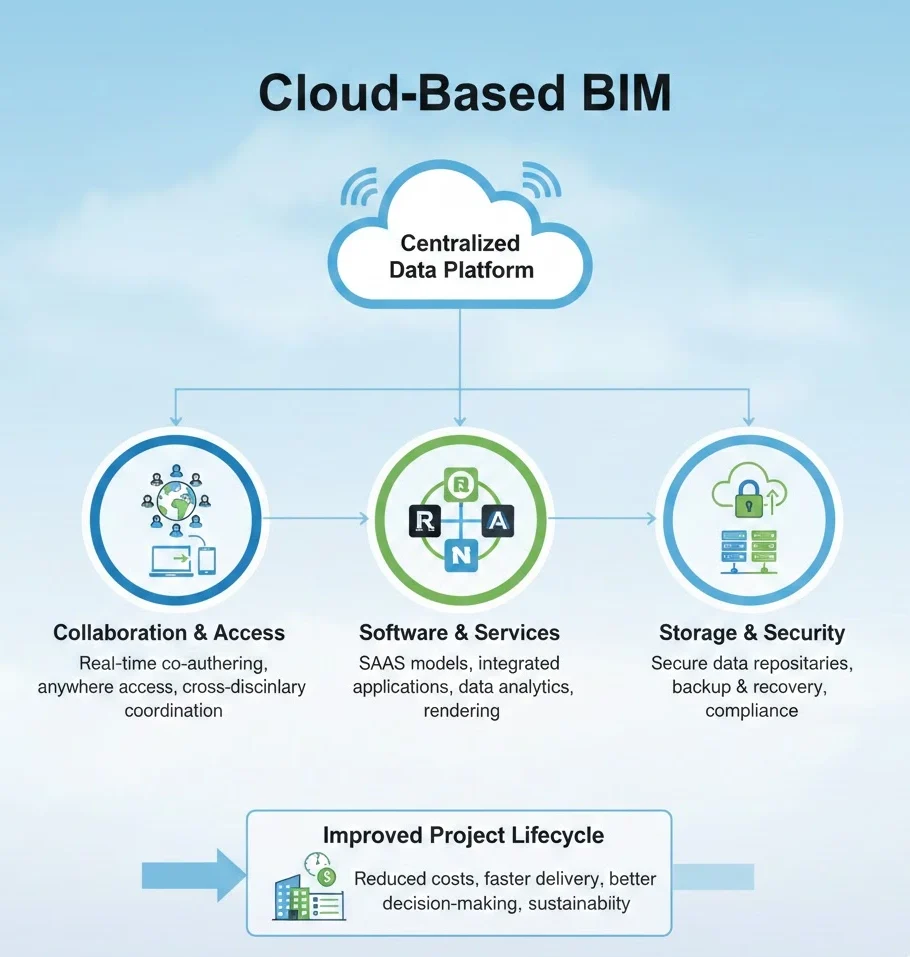
It is a cloud computing technology that creates digital representations of construction projects. It allows real-time collaboration, and stakeholders can interact with one another on a single file.
Why is Cloud-Based BIM Outranking Traditional BIM?
The latest cloud-based BIM is much more efficient than the traditional desktop file-based BIM model. It brings many benefits. To have a clear picture, let’s have a brief comparison between the two.
Click to read our detailed blog “What is BIM? A complete guide to building information modeling.”
Benefits Of Cloud-Based BIM For The AEC Industry
The AEC industry relies on Cloud BIM for smooth communication and collaboration. The BIM cloud truly fulfills this condition. Besides coordination, there are many other benefits of this cloud-based solution. Let’s discuss them all one by one.
Smooth communication
Communication and real-time BIM collaboration are the necessities of AEC professionals to bring successful projects. It streamlines the coordination among engineers, architects, and contractors. It helped them to review the model in real time, finding possible issues and prioritizing those issues for customized solutions.
Enhanced project outcome
When AEC professionals work in a BIM common data environment, they work efficiently and respond to the status updates and changes promptly. Further, working on the same file reduces the chances of working on an outdated version or not getting enough information. This ultimately leads to the construction team working and responding on time, ultimately enhancing the project outcome by delivering it on time.
Easy to Access Data
The BIM data on the cloud is easily accessible from anywhere. Moreover, it reduces the upfront cost because it does not require the expensive systems, hardwares and office space. You have to pay the subscription price, and the team will access the data from anywhere.
Streamline Clash Detection
When any design is uploaded to cloud BIM, then some tools like Autodesk BIM 360 perform automated clash detection and detect potential issues. All team members view these issues, and the team lead can assign these clashes to specified persons with a dedicated timeline to resolve them. As all team members view these clashes, they know they cannot work on the clash component until it is resolved.
Discover How Cloud-Based BIM Solves It All – Dive Deeper with Our Expert Resources!
Contact UsOnsite Communication
The final cloud-based BIM from AEC professionals is shared with the construction team. They can easily assess them on their phones, and it streamlines the on-site process and avoids errors and rework.
Increase Accountability
The cloud-based building information modeling can enhance accountability for all stakeholders as all team members are working on the same file, and any changes from any member can be viewed by the others. So all the team members work responsibly, leave the suggestions and comments that are beneficial for the final project. This feature is very helpful to reduce errors, improve teamwork, and finish the project with quality control standards.
Collaborative Decision Making
It is very easy through cloud BIM to make fast and informed decisions. Now all the team members can log in, access data, and discuss the specific points at the same time, and can integrate reviews and changes, which are viewed and approved by other members at the same time, helping them make the final mutual decisions.
Ease In Facility Asset Management
As the cloud solution keeps the record and history for all the design versions, it is very helpful for the facility asset managers. The owner of the place not only gets the final building, but they also get a full record of various trades, component installations, and it helps them in the renovation and project life cycle management.
New Features Automation
Any new feature is automatically updated in the cloud system for all team members. It improves model viewing, clash detection, and resolution finding. Due to the AI technology, many new features have been added to BIM in cloud platforms, which bring more accuracy and streamline the coordination.
Limitations of BIM in The Cloud
Despite many advantages, the cloud BIM platform still has some limitations. Let’s explore them.
Security Concerns
As the data is accessible to everyone, there are security concerns for highly confidential projects such as government-related defence projects.
Internet Connections
The cloud platform is accessible only when you have an internet connection. You cannot approach that data without the internet.
Interporibility
Interoperability is the capability of software to work with others. Cloud-based BIM supports many other software, but still, many advanced features are lacking, which need to be worked on.
Vendor Lock
Cloud platform stores data in its own version. If you decide to switch to another platform, then you have to convert the file to your desired format.
Payment Issues
When you are not working under a company or team, it becomes difficult to decide who will pay the upfront subscription cost.
Tips To Overcome These Limitations
- Choose a cloud provider that follows regulatory compliance, such as ISO 27001, SOC2, and GDPR, to avoid security risks.
- The team lead must check who has editing acces of the file.
- Use an encrypted method for data security and management
- Arrange trainings and sessions for the team so that they can use the Cloud platform efficiently.
Top BIM Cloud Platforms
How To Choose the Best Cloud BIM for Construction Work?
- First of all, identify your project scope requirements, goal, and the need to collaborate with the stakeholders for efficient project delivery.
- Decide whether you need an in-house team or if you can work with the remote workers in collaboration.
- Make sure that the platform you choose works with various software.
- Ensure code compliance and security measures to overcome the security risks.
- Check the vendor support for any query and their availability to address your concerns. Ensure that the platform you choose have latest AI features.
- Check the reviews of previous users; it will help you to go with the best one.
- Check the subscription cost and ensure that it is worth paying.
Future Trends And Innovations in Cloud BIM
In the future, cloud BIM will be more efficient through the integration of various latest technologies. A few of them are explained below.
Digital Twin Models
The big companies, such as Bentley and Autodesk Revit BIM 360 cloud, are already working on this technology. In this, the sensors are integrated into the building, and the digital twin model will not only be a source for construction, but it will also help after the construction. The sensor in the building sends the signal, and any fault, such as electrical wiring or plumbing pipes, can be easily detected and repaired.
If you want to read details about digital twins and how BIM Modeling creates one for your building, read our blog in detail.
AI and Machine Learning
The integration of AI and machine learning algorithms is also an innovation for cloud BIM. In this, the tools can predict the potential issues and clashes even before they occur on the construction sites. This approach is helpful to resolve the clashes, handle the emergencies responsibly, and reduce rework.
Augmented Reality And Virtual Reality
This technological approach is helpful for the contractor and engineers to have a virtual tour of the whole building. In this tour, they can see the pipes, cables, and wiring that are underground or behind the wall. It is also helpful to detect the issues and make informed decisions.
Sustainable Tools Integrations
As the awareness of sustainable building has increased, BIM Cloud will also work to integrate this technology. Some platforms are already working on this and allow the BIM model to analyze the carbon emissions for the construction of a project. It helps to choose the recyclable materials and energy-efficient approaches to reduce carbon emissions.
Click to read “How BIM improves energy efficiency and sustainable construction.”
Final Words
Cloud BIM is an effective platform for AEC professionals to work on a single file through a shared digital environment. It allows smooth communication and collaboration, and helps to bring more reliable projects which stay for a long time. In the future, AI-based tools such as digital twins, AR, VR, and sustainability analysis will make cloud BIM collaboration more beneficial for the AEC industry.
Frequently Asked Questions
What is Cloud BIM?
It is a platform that allows AEC professionals to work on a single shared digital environment where they can access the file in real time and make changes.
How to choose the best vendor for cloud BIM?
For this, you first have to know the requirements of the project, scope, and need for collaboration to create efficient designs.
Does Cloud BIM support large projects?
Yes, it does. Unlike traditional BIM, you just have to increase the subscription plan, and the vendor will adjust the space so that you can easily work and access the large projects.
What are the challenges to use cloud based BIM?
It is only accessible in the presence of an internet connection. Further, the security of confidential data is also a big concern because the file is shared with too many people.
