
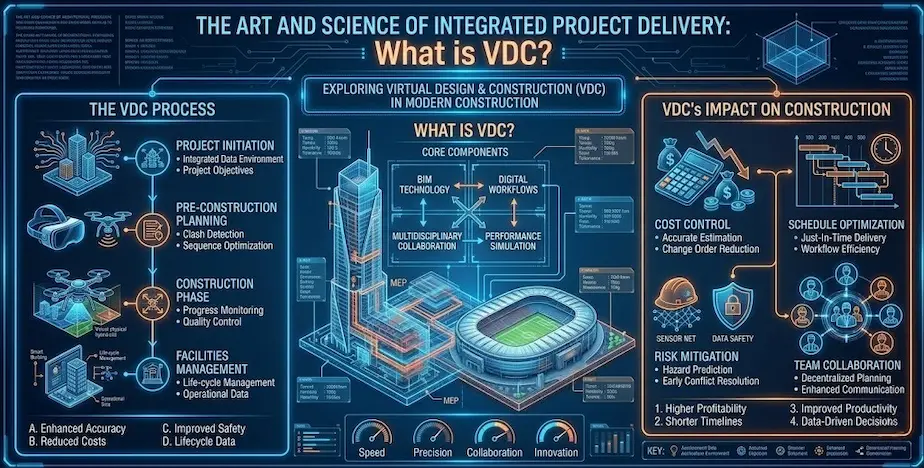
Virtual Design and Construction (VDC) is a project management methodology that uses digital models and real-time collaborative data to simulate a construction project before physical building begins.
Unintentionally working from different assumptions for the same construction project is a common issue in the US. This means the team members, including the architect, the structural engineer, the MEP consultant, and the GC, work from different documents.
In traditional projects, this happens during construction, where everything gets expensive. But in VDC, it happens during design, where teams can make changes to documents rather than on the job site. This means significant savings in both time and money. Let’s dive into the depths of VDC!
What is VDC?
Virtual Design and Construction (VDC) is an integrated project management approach that uses digital models, data, and simulation to plan, coordinate, and manage construction projects before and during physical building. It combines BIM modeling, process planning, cost modeling, and schedule simulation into a single coordinated project delivery framework.
History of VDC
VDC was originally developed at Stanford University’s Center for Integrated Facility Engineering in the early 2000s. The core idea was simple: if you could build a project virtually, before building it physically, the physical construction would be faster, cheaper, and more predictable.
The 2026 Version of VDC
In 2026, VDC has evolved well beyond its academic origins into a standard delivery methodology on large commercial, infrastructure, and industrial projects. It’s not a single tool or a single software platform.
Now, it has become an organizational approach, one that takes digital models and data as the primary medium through which project decisions get made, communicated, and documented.
VDC vs BIM: What’s the Difference?
Many industry experts remain confused by the two terms: VDC and BIM. Here is a clear distinction between them.
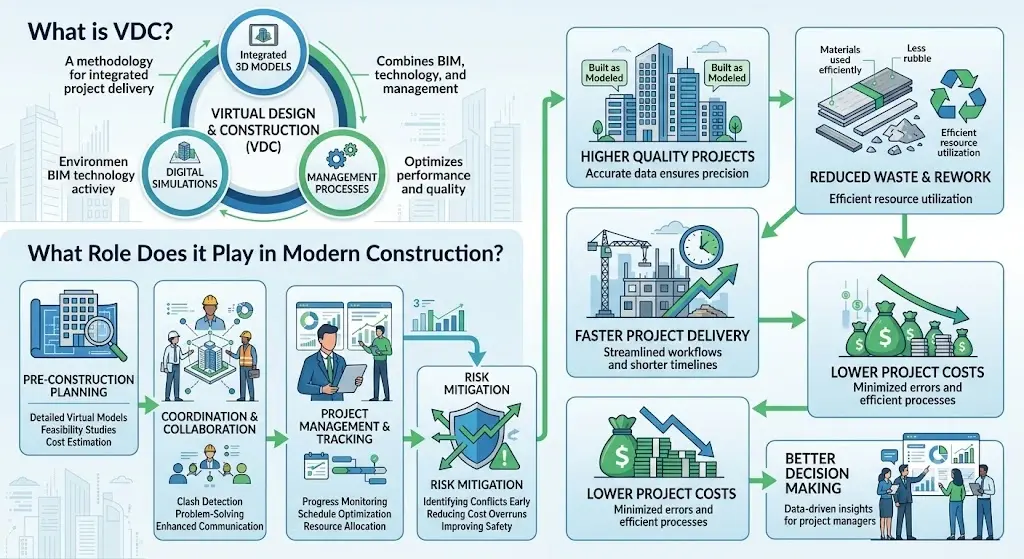
BIM (Building Information Modeling) is the technology, representing a major evolution when you look at the fundamental difference between AutoCAD and Revit. It’s the three-dimensional, data-rich model of a building that carries geometry, material specifications, structural properties, MEP system information, and cost data in a linked digital environment.
VDC is the methodology. It’s the organizational framework, the workflow structure, the team roles, and the decision-making process that uses BIM, along with other digital tools, to manage a project from inception through construction.
Put simply: BIM is the model. VDC is how the model gets used.
How VDC and BIM Work Together?
VDC cannot function without high-quality BIM services/modeling. The model is the medium through which every VDC workflow operates, including coordination, simulation, cost integration and constructability review. A VDC process built on low-fidelity, poorly structured BIM models produces low-fidelity results.
Therefore, BIM model quality standards matter extremely in a VDC environment. Level of Development (LOD) requirements, such as LOD 300 for coordination, LOD 350 for detailed trade coordination, and LOD 400 for fabrication, exist for a specific reason. VDC workflows depend on models that accurately represent what will actually be installed, not just what the design intends.
A model built with professional structural modeling services at LOD 200, where beams are represented as generic objects without connection details, can’t support a meaningful constructability review of structural connections. Similarly, an MEP model at LOD 300 without correct equipment dimensions can’t support accurate clash detection against architectural ceiling heights. The BIM model has to be built to the standard that VDC workflows require, which means BIM modeling in a VDC context is a more demanding discipline than BIM modeling for drawing production alone.
What are the Core Components of VDC?
VDC isn’t a monolithic system. It’s a set of integrated practices that can be deployed individually or together, depending on project complexity, contract delivery method, and team capability. Understanding its components explains why VDC delivers the outcomes it does.
BIM as the Coordination Foundation
Every VDC workflow starts with a BIM model, or more accurately, a set of federated BIM models from every discipline. The architectural model, the structural model, the MEP models, and increasingly the site logistics model all combine into a single federated environment where the entire project can be reviewed simultaneously through dedicated BIM coordination services.
This federated model is the foundation of VDC coordination. It’s where…
- Automated MEP clash detection services happen, meaning that any structural beam that conflicts with an HVAC duct gets flagged before fabrication, not after installation.
- Constructability reviews occur, meaning that the sequence of concrete pours gets evaluated against crane reach and access constraints.
- Design changes get evaluated for their ripple effects across disciplines before they’re issued as formal revisions.
In 2026, cloud-connected BIM environments have made federated model coordination faster and more accessible than before. Project teams that are geographically distributed can coordinate in the same model environment simultaneously, without file transfer delays or version confusion issues.
4D Scheduling: Connecting Model to Time
One of VDC’s most powerful components is the advanced 4D BIM simulation service. It is the linking of the BIM model to the construction schedule so that the sequence of construction can be visualized, tested, and optimized before mobilization.
In a 4D simulation, each model element is assigned to a scheduled activity. The simulation then plays back the construction sequence in visual form, showing…
- Which elements get installed in which order
- Where trade stacking conflicts occur
- Where crane coverage is inadequate for a given work zone
- And whether the planned sequence creates access problems for subsequent trades.
For a project manager or superintendent watching a 4D simulation, this is the first time they can actually see the project being built before physical construction begins. The conflicts that a 4D simulation reveals are specific coordination failures that, without simulation, would materialize as field problems with actual cost and schedule consequences.
On a complex multi-story project, a single sequence conflict caught in 4D simulation can represent weeks of scheduled recovery and high, unplanned costs. Finding it in the model costs nothing but review time.
5D Cost Integration: Connecting Model to Budget
5D BIM takes the 4D model one step further by integrating cost data, utilizing 5D BIM cost estimation services to track budgets in real time. Every model element carries not just geometry and schedule information but cost information. So when a design decision changes, its cost impact is calculable immediately.
In VDC practice, 5D integration changes the design review conversation fundamentally. When an architect proposes switching from a precast concrete facade to a metal panel system, the 5D model calculates the cost data, including material cost change, labor impact and schedule effect, in the same session. This way, the project owner sees the cost consequence of the design decision before approving it.
Virtual Mock-Ups and Constructability Reviews
Traditionally, before VDC, constructability reviews happened on paper; experienced superintendents and PMs pored over drawings, relying on field instincts to catch installation conflicts and sequence problems. It was valuable, but limited by what 2D drawings can communicate and what human pattern recognition can catch across a complex document set.
In VDC, constructability reviews happen in the model. Prefabrication assemblies are modeled before fabrication to verify they’ll fit the installed conditions. Structural connection details are reviewed in three dimensions to confirm bolt access and the erection sequence. MEP coordination zones are walked through virtually before any trade is implemented.
And virtual mock-ups take this further. For complex elements handled by architectural BIM modeling services like curtain wall systems, precast panel connections, and specialty interior assemblies, VDC teams build virtual mock-ups in the model environment, reviewing installation sequence, tolerances, and interface conditions before committing to fabrication. The cost of a virtual mock-up is a fraction of the cost of a physical one, and the information it provides is comparable.
Lean Construction Integration
VDC doesn’t operate independently of project delivery methodology. It integrates most powerfully with Lean construction approaches, particularly the Last Planner System and pull planning methods that involve field trade supervisors in production planning.
In a VDC-enabled Lean workflow, the BIM model provides the visual environment where production planning conversations happen. Trade managers pull plans against the model, reviewing installation sequences in three dimensions and identifying constraints that aren’t visible in a traditional schedule. This way, the model becomes the shared reference point for collaborative production planning,
This integration between VDC and Lean is where some of the most significant productivity gains on complex projects come from. When the people doing the work can see exactly what they’re building, production planning becomes more accurate.
What are the Benefits of VDC for Construction Teams?
The outcomes that VDC consistently delivers on projects where it’s properly implemented are measurable and documented. Simply put, VDC is highly beneficial for construction teams. Continue reading to explore HOW.
Clash Detection Before Fabrication
On projects with comprehensive VDC coordination, field-discovered coordination conflicts drop dramatically compared to traditionally coordinated projects. Hard clashes caught in the model cost review time, while hard clashes discovered in the field cost rework, material waste, schedule impact, and often a subcontractor dispute.
Faster, More Confident Approvals
Permit submissions that include VDC-coordinated BIM models and 4D simulation demonstrate a level of project readiness that accelerates regulatory review. Municipal reviewers in several major US markets now actively prefer coordinated model submissions because they reduce rework and correction cycles.
Reach out to discuss how VDC fits your next project.
Contact UsPredictable Schedule Performance
Projects using 4D simulation for construction sequence planning consistently outperform schedule benchmarks compared to projects planned with traditional CPM alone. The simulation identifies sequence conflicts and resource constraints before they become field problems.
Owner Confidence through Transparency
When owners engage with a 3D model of their project, their design approval process becomes faster, and their construction-phase change requests are reduced. VDC makes the project real for owners before it’s built, which is one of the most direct ways to prevent the late-stage design changes that devastate project budgets and schedules.
Reduced RFI Volume
RFIs are, in most cases, signs of coordination failures that should have been resolved in the design documents. A VDC process that resolves those failures before the permit set is issued produces drawings where the RFI volume during construction is very small, proving the value of BIM in reducing constant errors in designs.
VDC in Real-World Construction
● Hospital Expansion, Seattle
A 6-story hospital expansion project in Seattle engaged a VDC team at the end of schematic design. The mechanical, electrical, and plumbing systems for a hospital are among the most complex coordination challenges in commercial construction. Why? Because infection control requirements drive specific air pressure relationships between spaces, emergency power systems require dedicated routing paths, and medical gas systems have clearance requirements that conflict with standard MEP routing assumptions.
The VDC coordination process ran 16 weeks of intensive federated model review before permit submission. The team identified 847 clashes in the federated model, 312 of which were classified as critical (hard clashes requiring redesign). Every one of those 312 critical conflicts was resolved before the permit set was issued.
During construction, the project generated fewer than 2 field RFIs per 10,000 square feet, well below the industry average for hospital projects of comparable complexity. The project superintendent credited the VDC coordination process directly: the field teams were building from drawings that reflected what was actually possible in the space, not drawings that assumed coordination would get worked out later.
● Data Center, Northern Virginia
A 180,000 sq ft hyperscale data center project used 4D simulation to plan the construction sequence for a modular mechanical and electrical plant that had to remain partially operational during phased expansion. The constraint created sequence dependencies that a traditional CPM schedule couldn’t adequately communicate to the field.
The 4D simulation visualized 28 distinct installation phases, each with specific spatial constraints, temporary power requirements, and access limitations. The simulation identified 3 phase transitions where the planned sequence would have required shutting down live equipment, a violation of the owner’s operational continuity requirement.
Those 3 sequence conflicts were identified in the model during preconstruction planning. The sequence was revised. No operational interruptions occurred during construction. From the owner’s perspective, the project simply worked, but from the VDC team’s perspective, it worked because 3 problems that would have stopped the project were found and solved before a single cable tray was installed.
What Challenges Can You Encounter in VDC Adoption in 2026?
VDC delivers strong outcomes when it’s implemented correctly. It also creates specific challenges that you need to understand before committing to it.
Front-Loaded Investment
VDC requires more time, coordination effort, and model development work in preconstruction than traditional project delivery. The return on that investment comes during construction in reduced RFIs, fewer change orders, and better schedule performance. Owners who don’t understand this front-loaded cost structure sometimes resist VDC fees during preconstruction and then pay multiples of those fees in construction-phase problems.
Team Alignment Requirements
VDC only functions if every project team member, including architect, structural engineer, MEP consultants, GC and major subcontractors, participates in the coordination process with models that meet the required LOD standards. A federated model where two disciplines are at LOD 350 and one is at LOD 200 produces coordination results that are incomplete in exactly the zone where the low-fidelity model operates.
BIM Execution Planning
The BIM Execution Plan, which is the project-specific document that defines modeling standards, file sharing protocols, LOD requirements, coordination meeting schedules, and clash review processes, is the operational foundation of every VDC workflow. Projects that start VDC coordination without a completed, agreed-upon BIM execution plan routinely experience the coordination failures the plan was designed to prevent.
Software Interoperability
In 2026, the interoperability between BIM platforms has improved significantly, but hasn’t been fully solved. An architect on Revit, a structural engineer on Tekla, and a mechanical consultant on AutoCAD MEP all produce models in different native formats, making it easy to fall into common MEP BIM mistakes if the workflows aren’t fully aligned.
IFC export protocols and platform-specific import workflows manage the translation. Still, navigating these workflows requires clear discipline, a major shift for teams moving from CAD vs BIM environments, and the final quality depends on each discipline’s IFC export.
What is the Future of VDC Beyond 2026?
VDC is not a mature technology in the sense that it has reached its maximum height. It’s a maturing methodology that is actively evolving in several directions simultaneously.
Generative Design Integration
This technology is beginning to appear in VDC workflows, which means AI tools that generate structural configurations, MEP routing paths, and space planning options that satisfy specified constraints, presenting the design team with optimized starting points rather than blank models. The VDC process then evaluates these options against cost, schedule, and constructability criteria in a model environment.
Real-time Field Data Integration
This advancement is closing the gap between the virtual model and the physical project. Site scanning technologies like LiDAR, photogrammetry, and drone survey now update as-built conditions into the BIM model at intervals measured in days rather than weeks. The VDC model becomes a live representation of the project as it’s built, not just as it was designed.
Digital Twin Transition
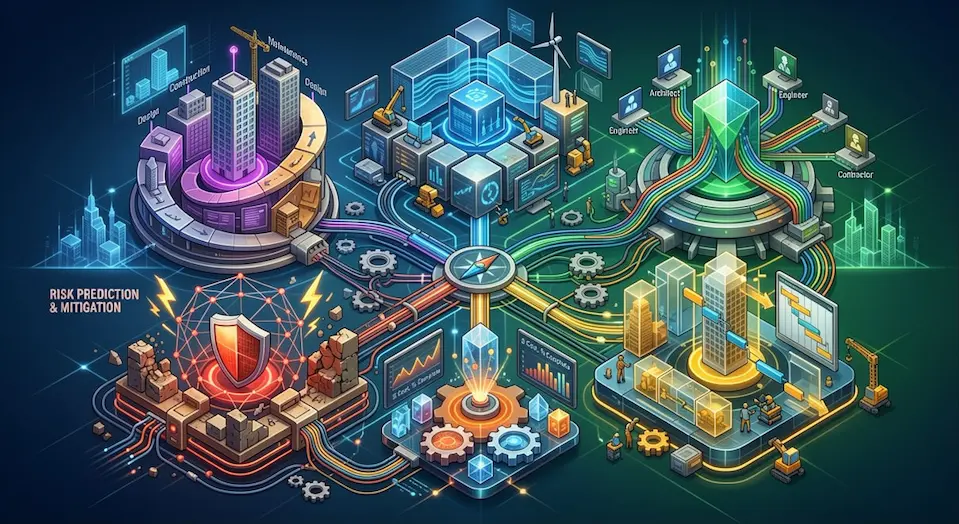
It is becoming a formal project deliverable expectation on institutional and infrastructure projects. At project handover, the VDC model created during design and construction becomes a digital twin, which is a live model fed by real-time data and connected to the building’s systems.
For owners operating complex facilities, this long-term lifecycle intelligence is seamlessly unlocked through specialized Digital Twin services, providing one of the clearest demonstrations of VDC’s total project value.
Predictive Project Controls
Future systems will use AI analysis of VDC model data, schedule performance, and cost tracking to forecast final project outcomes with increasing accuracy at earlier points in the construction timeline. The model that started as a coordination tool becomes a predictive instrument for project financial and schedule performance.
Conclusion
VDC is the answer to a question that construction has been asking since the first complex building went up: how do you build something right the first time, when so many different teams, systems, and variables have to come together in the right order at the right time?
The answer has always been: plan it better before you build it. VDC is the methodology that makes planning solid, visual, data-driven, and collaborative in ways that traditional preconstruction processes have never been.
The projects that run on VDC, with high-quality BIM models as their coordination foundation, 4D simulation as their schedule intelligence, and 5D integration as their cost feedback system, deliver results that traditionally coordinated projects can’t match. This means fewer field conflicts, faster approvals, more predictable schedules, and lower change orders.
In 2026, VDC isn’t the future of construction delivery. For the firms doing the most complex, highest-stakes work in the industry, it’s already the present. At BIM Modeling, our BIM modeling and VDC coordination services are built for real construction projects, the ones where coordination failures are expensive, sequence conflicts are costly, and getting it right the first time isn’t optional.
Frequently Asked Questions
What does VDC stand for in construction?
VDC stands for Virtual Design and Construction. It’s an integrated project delivery methodology that uses digital models, data, process simulation, and coordinated team workflows to plan and manage construction projects before and during physical construction.
Is VDC the same as BIM?
No. BIM is the technology, the three-dimensional, data-rich digital model. VDC is the methodology, the organizational framework and workflow processes that use BIM, along with other digital tools, to manage project decisions, coordination, and delivery.
What are the main components of a VDC workflow?
The core components are federated BIM coordination, 4D schedule simulation, 5D cost integration, virtual constructability reviews, and Lean production planning conducted in the model environment. Individual projects may use all or some of these components depending on complexity and delivery requirements.
What is 4D BIM in VDC?
4D BIM links the three-dimensional model to the construction schedule, allowing the project team to simulate the construction sequence visually, identifying trade stacking conflicts, access constraints, and sequence dependencies before mobilization. It turns the project schedule into a visual, spatial tool rather than a list of activities.
What is 5D BIM?
5D BIM adds cost data to the 4D model framework. Each model element carries geometry, schedule, and cost information, so that design changes automatically produce cost impact calculations without a separate estimating process. It integrates cost discipline into design decision-making in real time.
How does VDC reduce construction costs?
VDC reduces costs primarily through clash detection that prevents field-discovered coordination failures, 4D simulation that prevents sequence conflicts and their associated rework, and 5D integration that prevents late-stage design changes driven by budget surprises. Each of these mechanisms converts potential field costs into preconstruction coordination time, which is significantly less expensive.
What is a BIM Execution Plan in VDC?
A BIM Execution Plan (BEP) is the project-specific document that defines modeling standards, LOD requirements for each discipline, file sharing protocols, clash review schedules, coordination meeting structure, and model handover requirements. It’s the operational framework that makes multi-firm VDC coordination function consistently.
What projects benefit most from VDC?
Projects with high MEP complexity, like hospitals, data centers, laboratories, and complex mixed-use buildings, benefit most directly from VDC coordination. High-rise residential, infrastructure, and industrial projects also see strong outcomes.
Is VDC worth the investment for mid-size projects?
Yes, with appropriate scaling. Not every mid-size project needs a full VDC program with dedicated BIM coordinators and weekly clash review meetings. But even a simplified VDC approach delivers measurable value on projects above roughly $5 million in complexity.
How does VDC connect to project controls?
VDC model data (schedule links, cost integration, as-built condition tracking) feeds directly into project controls functions. When the model is updated against actual construction progress, it becomes the primary data source for earned value calculation, cost forecasting, and schedule performance measurement.
