

A duct hits a beam. Nobody notices until the crew shows up to hang it. That single moment is where most construction budgets quietly start bleeding, and it happens on more projects than the industry likes to admit.
BIM coordination exists to catch that duct before it ever reaches the beam. It’s the process of merging architectural, structural, and MEP models into one shared environment so conflicts surface on a screen, weeks or months before they’d surface on scaffolding. The financial case is no longer theoretical. A Haskell case study on a $230 million design-build project found that a $200,000 investment in BIM coordination returned more than $2.5 million in savings. That’s a 10x return driven almost entirely by avoided rework. That’s the number worth sitting with before reading further.
What Is BIM Coordination?
BIM coordination is the process of combining discipline-specific models (architectural, structural, mechanical, electrical, plumbing) into a single federated model to detect and resolve conflicts before construction begins.
Instead of reviewing five sets of separate drawings, the project team works from one model that shows how every system occupies the same physical space.
Clash detection is the part people picture first, but it’s only one piece. A full coordination process also covers version control, issue tracking, responsibility assignment, and keeping one authoritative source of project data. The goal isn’t a coordinated model for its own sake. The goal is a project team making decisions based on the same accurate information, on the same day, instead of on five different Tuesdays.
Why BIM Coordination Matters More in 2026 Than It Did Five Years Ago
Buildings have gotten denser, systems have multiplied, and delivery timelines have compressed. All three trends raise the odds that two disciplines occupy the same 18 inches of ceiling space without knowing it. The data backs up how much this now costs when it isn’t caught early.
| Metric | Reported Figure | Source |
| Construction cost reduction from BIM adoption | 10% – 20% | Global BIM studies, ARKANCE |
| Rework reduction from BIM coordination | Up to 40% | Global BIM studies, ARKANCE |
| Project delivery speed improvement | 20% – 50% faster | Global BIM studies, ARKANCE |
| Contract value saved via clash detection (infrastructure case) | 20% of contract value | Construction Management and Economics journal |
| Material/rework cost savings, Malaysian Police HQ case | 15% | Kermanshahi et al., 2020 |
| Rework typically avoidable through early coordination | 5% – 12% of contract value | ENG / archBIM industry benchmarks |
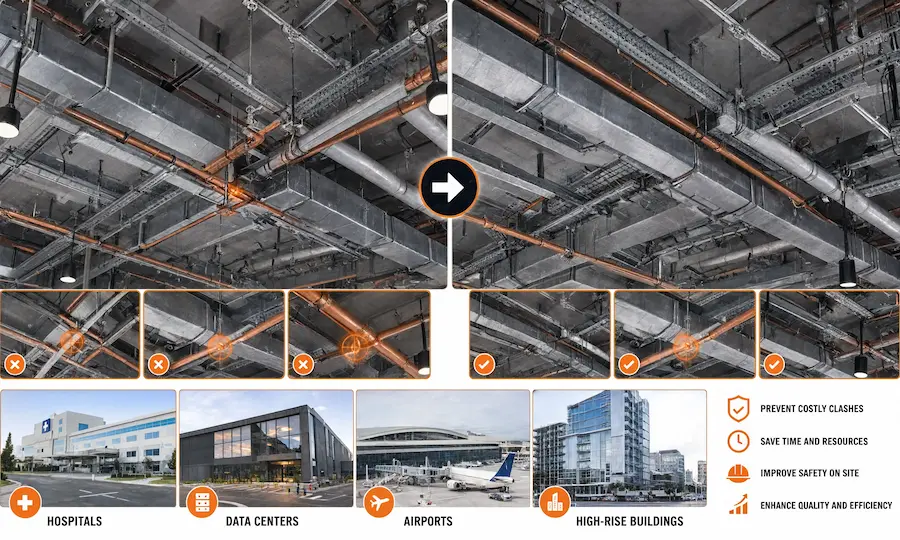
None of this is abstract for a project team standing at a $30 million budget with 10% of it exposed to rework, roughly $3 million on the table. Clash detection doesn’t eliminate that risk entirely, but every clash caught in the model instead of the field is money that stays in the project instead of leaking into change orders.
How BIM Coordination Actually Works, Step by Step
Every project runs its own version of this, but six stages show up consistently across teams that do it well.
- Establish project standards.
- Federate the discipline models.
- Run clash detection.
- Prioritize what actually matters.
- Assign ownership.
- Review, update, repeat.
BIM Coordination vs. Traditional Coordination
Before federated models became standard practice, coordination ran on printed drawings, PDF markups, and long email chains. That approach can work on a small renovation. It breaks down fast on anything with real MEP density.
| Traditional Coordination | BIM Coordination |
| Separate discipline drawings | Shared, federated model |
| Manual visual cross-checking | Automated clash detection |
| Email threads and marked-up PDFs | Centralized issue tracking |
| Version confusion across teams | Controlled model revisions via a CDE |
| Conflicts found on site | Conflicts found in design |
| Rework absorbed after installation | Conflicts resolved before materials ship |
The real shift isn’t the move from 2D to 3D. It’s that project information becomes centrally managed and continuously updated, instead of scattered across whoever last touched a drawing.
The ROI of BIM Coordination With Case Studies
Return-on-investment claims in construction tech are usually vague. BIM coordination is one of the few areas with hard published numbers behind it.
| Project / Study | Investment | Documented Return |
| Haskell, $230M design-build food facility | $200,000 in BIM coordination | $2.5M+ in savings — a 10x ROI |
| DBIA case study, VDC-led coordination | $200,000 VDC labor effort | $2.22M rework savings + $542K schedule savings |
| Asian rail infrastructure project | BIM coordination across disciplines | 3,000+ critical clashes resolved; ~12% cost savings |
| Malaysian Police Headquarters | BIM-based clash prevention | 15% material and rework cost reduction |
The pattern across all four case studies is the same: the earlier a clash surfaces, the cheaper it is to fix. A conflict caught in the model costs a few minutes of a coordinator’s time. The same conflict caught on site costs demolition, re-fabrication, idle trades, and a schedule that just moved right.
Get BIM coordination that catches clashes early.
Contact UsSoftware Used for BIM Coordination
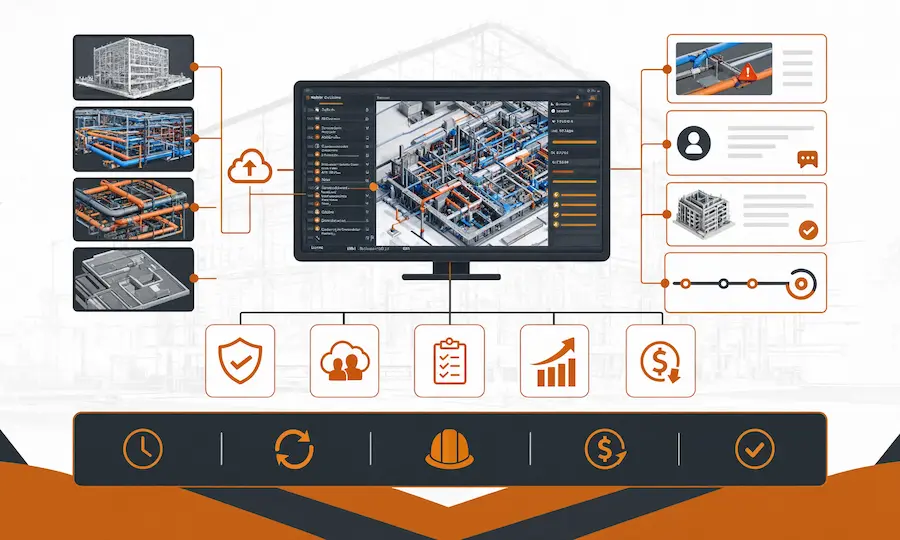
No single application runs the whole process. Most coordination workflows stitch together an authoring tool, a federation and clash-detection tool, and a cloud environment for sharing and tracking issues.
| Tool Category | Examples | Role in the Workflow |
| BIM authoring | Autodesk Revit, Bentley OpenBuildings Designer | Each discipline builds its own intelligent 3D model |
| Model federation & clash detection | Autodesk Navisworks Manage, Revizto | Combines models, runs automated clash tests and generates reports |
| Cloud collaboration / CDE | Autodesk Construction Cloud, Trimble Connect, Aconex | Centralizes documents, tracks issues, manages version control |
| Open data exchange | IFC, openBIM workflows | Lets teams on different software exchange model data without lock-in |
Because teams rarely standardize on one vendor across a project, Industry Foundation Classes (IFC) matter more than most people realize. Recent NBS survey data shows 56% of respondents now exchange information in IFC format and 36% use COBie.
ISO 19650 and the Common Data Environment: Why Standards Matter
BIM coordination without a shared standard for managing information tends to collapse into version chaos. ISO 19650 exists to prevent exactly that. It defines how information is created, checked, shared, and archived across the life of a project, using a Common Data Environment (CDE) as the single source of truth.
Government mandates are accelerating adoption well beyond the UK, where ISO 19650 originated. Singapore, Germany, and the UAE now require ISO 19650-aligned BIM on public infrastructure work, and U.S. federal guidance is moving in the same direction even without a formal legal mandate yet. The market reflects that momentum: MarketsandMarkets projects the global BIM market growing from roughly $9.03 billion in 2025 to $15.42 billion by 2030, an 11.3% annual growth rate driven largely by standardized, cloud-based coordination workflows.
MEP Coordination And BIM
Not all clashes are created equal, and MEP coordination is where the sharpest savings concentrate. Mechanical, electrical, and plumbing systems compete for the same narrow ceiling void (often a space measured in inches, not feet) which makes MEP the single densest source of conflicts on almost any commercial or healthcare project.
A BIM-based hospital project in Vietnam surfaced 36 significant MEP clashes during coordination review, each one a conflict that would otherwise have stalled a trade mid-installation. On the Asian rail infrastructure project referenced earlier, more than 3,000 clashes were resolved digitally before construction, the bulk of them MEP-related, contributing directly to the 12% cost saving reported on that job.
The pattern holds across project types: whenever ductwork, cable tray, sprinkler piping, and structural elements are modeled together early, model coordination surfaces the conflict while it’s still just a few clicks to fix, not a demolished section of finished ceiling.
- Ductwork vs. structural beams and joists is the most common MEP clash category by volume
- Cable tray vs. sprinkler piping is the most frequent in ceiling voids with multiple parallel systems
- Equipment placement vs. maintenance access is a clash that often isn’t geometric but functional, and easy to miss without a dedicated access-clearance check
- Riser alignment across floors is a clash type that only becomes visible once multi-level models are federated together
What a BIM Coordinator Actually Does Day to Day
The title gets thrown around loosely, so it’s worth being specific. A BIM coordinator isn’t just the person who presses “run” on clash-detection software. The job is everything around it: setting up the federated model correctly, deciding which of the software’s flagged conflicts are real problems versus noise, chasing down the right owner for each issue, and keeping the model current as design changes roll in week after week.
On a well-run project, a BIM coordinator also acts as a translator between disciplines. An architect and a mechanical engineer rarely speak about ceiling space the same way; the coordinator’s job is turning a geometric overlap into a plain-language issue that both sides can act on quickly. That communication layer, as much as the software itself, is what separates coordination that actually prevents rework from coordination that just produces reports nobody reads.
Coordination and BIM in architecture adds value on nearly any multi-discipline project, but the return compounds as system density rises. The more trades competing for the same ceiling void, the more a federated model earns its cost.
- Hospitals and healthcare facilities
- Data centers
- Airports and transportation hubs
- High-rise residential and mixed-use towers
- Industrial and manufacturing plants
- Renovation and retrofit work
Common BIM Coordination Challenges (and How to Avoid Them)
Starting Coordination Too Late
Waiting until the design is nearly finished to start coordinating makes every fix more expensive. Start the federated model as early as discipline models exist in any usable form, even in rough shape.
Poor Version Control
Teams working from different model versions recreate the exact chaos BIM was supposed to eliminate. A managed CDE, aligned to ISO 19650 principles, closes this gap by controlling which revision is live.
Treating Every Clash Equally
A software report might list 2,000 clashes; maybe 40 of them matter. Prioritize by safety risk, cost impact, and construction sequence.
No Clear Owner for Open Issues
An unassigned clash tends to stay unresolved indefinitely. Every issue needs a named owner, a deadline, and a status tracked inside the platform, not buried in a meeting note.
Overbuilding the Model
Excess geometric detail slows everyone down without improving coordination outcomes. Model to the level of detail the current project stage actually needs.
Best Practices for Successful BIM Coordination
- Maintain one authoritative source of project information, not parallel copies across email
- Run coordination meetings on a fixed, recurring schedule
- Review the federated model before every major design milestone, not just before construction start
- Resolve high-impact clashes first; log low-impact ones for a later pass
- Track every issue to formal closure, with a documented resolution
- Confirm every team member is pulling from the current approved model before starting new work
Frequently Asked Questions
What is BIM coordination?
BIM coordination is the process of merging discipline-specific models into one federated model to identify and resolve design conflicts before construction starts, reducing rework and improving schedule reliability.
What does a BIM coordinator actually do?
A BIM coordinator federates discipline models, manages clash detection cycles, prioritizes and assigns issues, and keeps project data current under a Common Data Environment, in line with ISO 19650 principles.
How much does BIM coordination actually save?
Published case studies report returns ranging from 12% to 15% in avoided rework and material costs, up to a documented 10x return on investment on a $230 million project where a $200,000 coordination effort avoided over $2.5 million in downstream costs.
What software is used for BIM coordination?
Common tools include Autodesk Revit and Bentley OpenBuildings Designer for authoring, Autodesk Navisworks Manage and Revizto for federation and clash detection, and Autodesk Construction Cloud or Trimble Connect as the shared CDE.
Is BIM coordination only worthwhile on large or complex projects?
Larger, MEP-dense projects see the biggest documented returns, but any project with more than one discipline sharing physical space benefits from catching conflicts in a model instead of on site.
What is a Common Data Environment (CDE)?
A CDE is the single managed source for collecting, storing, and distributing project information (models, documents, and data) across the whole team, as defined under the ISO 19650 standard.
The Future of BIM Coordination
The pending revision to ISO 19650 is set to simplify terminology, replace the old Level of Detail (LOD) language with Level of Information Need (LOIN) drawn from ISO 7817-1, and extend the standard’s scope across the full asset lifecycle.
Coordination is steadily shifting from a design-phase task into a continuous information-management discipline that follows the building for decades, not just through substantial completion. If you do not want to be left behind in the world of BIM coordination, contact our BIM Modeling Services team and get expert insights for your next construction project.
