
In developed America, the demand for BIM is increasing to address challenges and establish a strong market reputation. BIM standards USA are created as per state environment and public needs, as each state has its own legal regulations, priorities, and demands. Whenever you get a BIM model, make sure that it meets the building standards and local codes. Suppose it does not comply with the codes. In that case, you may fail to win the bid as compliance is not only essential for a smooth process but also demonstrates your professional behavior and the trustworthiness of your company.
Dodge Construction Network always mentions the state after analysis and study. According to them, in 2024, “more than 72% of US public construction projects with budgets exceeding $50M will now include some form of BIM requirement”. If every contractor and architect wants to manage cost, time, and budget effectively, then it is very important for them to get a BIM model. It also supports bringing the expected results as you imagined. If you want to know more, get our state BIM guidelines.
What Are BIM Guidelines And Standards?
BIM guidelines and BIM standards are different but related. They have their own specifications and specialities, especially when it comes to BIM compliance by state. Let’s dive into the details.
BIM Guideline
BIM guidelines help project owners and MEP engineers use models throughout the construction process. When you have flexible BIM models for your project, you not only easily accommodate new additions in the future, but you are also able to strategize in advance so that you can reduce overhead costs and material waste while maintaining new specifications. It also supports strong communication, increases consistency, and promotes efficiency.
BIM Standards (Mandatory)
On the other hand, BIM standards USA focus on compliance and maintaining the project lifecycle until the end. If you ignore BIM standards, you may face additional costs, delays, unnecessary problems, and penalties. To ensure accuracy and transparency, it provides you with the LOD that your project requires.
Frameworks that are used to support both BIM guidelines and BIM standards.
NBIMS-US v3
It is used for team collaboration, data sharing, and interoperability.
ISO 19650
It allows you to manage building infrastructure and organize construction data, which increases credibility.
AIA E202
It defines the BIM implementation plan, development level, authoring, and BIM protocols.
Why BIM Standards Matter For Public & Private Projects?
Over the years, BIM adoption in USA has been evolved with many new software and tools. Whether it is a private or public project, obtaining a BIM model is crucial to achieving the desired results. It also reduces the chances of rejection in bid submissions as properly compliant BIM models demonstrate your competence and professionalism to clients. Compliance also ensures efficiency. Through BIM models, you can also change the design if needed before the first brick is laid on site at no additional cost, which in turn enhances ROI.
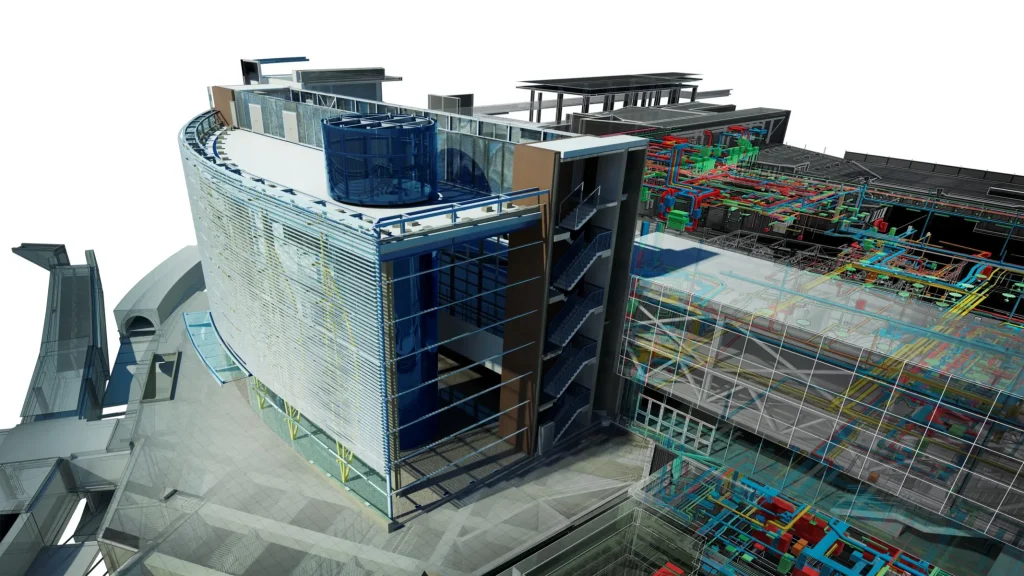
BIM adoption in the USA is not just helping to visualize interiors, rooms, walls, and lawn, but also provides lifecycle-ready data and meets BIM requirements for contractors, including material costs, labor costs, maintenance measures, facility management proposals, and project timelines. All of these factors put you at ease from start to finish.
Federal BIM Standards & National Guidance
Each state has its own federal requirements that are essential for BIM in construction. It is also useful to share data and facility management. Main federal guidance, such as GSA and USACE, manages the rules and shapes the culture of the project cycle. Further, federal projects also create BEPs and sample contract clauses that vendors use as a baseline.
Let’s discuss the main Federal guideline in detail
General Services Administration BIM Guide (GSA)
This is the most important guideline, which focuses on design, construction, and lifecycle management and ensures that the project is delivered with accuracy and authenticity.
U.S. Army Corps of Engineers USACE BIM Roadmap
These guidelines apply to high-precision military projects and are influential in setting a base for the state BIM standards to detect clashes and resolve the issues.
National BIM Standard – United States (NBIMS-US)
The National Institute of Building Sciences (NIBS) manages these guidelines. They focus on sharing BIM models with all stakeholders through shared platforms and influence the state BIM agencies to follow these rules.
How Federal Guidelines Affect the State-based Guidelines
- When GSA or USACE is adopted by the high-level military and other federal construction projects, then they set a baseline to follow for the states.
- Federal projects require high-end technology, which creates competition among BIM providers, and state-based BIM providers also try to follow the same tools and software to bring authenticity to their models.
Consideration Stage
State-by-State BIM Guidelines In The USA (2025 Update)
Each state has different public construction BIM mandates. Let’s discuss top 10 state BIM guidelines in detail
Connecticut DAS BIM Standards (LOD, naming, COBie data)
Connecticut’s Department of Administrative Services (DAS) is strict about enforcing the rules. Compliance is mandatory to win bids for a construction project and to properly construct a building. On the other hand, some elements are recommended, such as modeling best practices. This comprehensive report ensures that the final design of the project is perfect and meets building standards.
Texas Facilities Commission BIM Guidelines
In Texas, BIM adoption is mandated for large-scale projects. BIM guidelines help you understand how BIM supports planning, construction, maintenance, and facility management. Additionally, structural data and BIM templates are recommended.
Ohio DAS BIM Protocol
The state BIM protocol is a core part of the Department of Administrative Services (DAS) construction plan. For compliance, construction implementation plans and assist worksheets are mandatory, but core deliverables that include COBie and LOD are critical.
Wisconsin BIM Standards
Wisconsin’s Department of Administration (DOA) requires a deliverable checklist. Their primary focus is on whether the BIM is error-free and the client can easily view the design. In this case, best practices are recommended that help identify conflicts, risk factors, and avoid costly mistakes.
California BIM4I (Caltrans)
BIM is mandatory in California for single projects such as the construction of bridges, roads, and terminals, but compliance depends on the type of sector you are working in. Compliance is mandatory for specific projects such as infrastructure and public spaces.
Florida BIM Initiatives
In Florida, BIM is like a backbone in large projects like highway and airport construction. In some other projects, BIM is recommended simply to help streamline projects, eliminate conflicts, reduce overhead costs, and maximize ROI. Further, it helps to properly visualize the design before construction starts.
New York OGS/DDC BIM Initiatives
The New York Department of Construction provides detailed guidelines to contractors and project owners, such as BEp, deliverable requirements, and compliance with construction standards. BIM is mandatory for large-scale projects, but practices are recommended for smaller-scale projects.
Minnesota State BIM Guideline
Minnesota has developed BIM guidelines to increase project accuracy and success. This is not just to assist with facility management and conflict reporting, but to ensure the project is of high quality and long-term functionality. If you want to share models with project owners smoothly, then practices are recommended.
Massachusetts DCAMM BIM Guide
If you are managing a construction project in Massachusetts, it is mandatory to meet BIM guidelines for deliverables to meet the LOD requirement. BIM is recommended for smaller projects, such as residential or retail spaces, that help complete the project as planned.
Virginia VDOT BIM Standards
The Virginia Department of onstrution has mandated 3D models for every project because they help you preview the final look and allow you to change the design before the first brick is laid. Strict compliance by state applies to electrical work and data transmission.
Summary
Putting it short, all states in the country have their own rules and regulations. Some rules are mandatory, and some are recommended. A BIM provider needs to follow both mandatory and recommended clauses to give a detailed 3D, data-rich model to their contractor colleagues so that they can work confidently and make informed decisions to maintain a smooth construction process.
Need help meeting Connecticut DAS or Texas or any other state BIM standards? Let’s talk.
Contact UsCommon Elements Across State BIM Standards
We have explained the elements in a step-by-step manner below.
Typical BIM Deliverables
● LOD 300/400 Models
LOD stands for Level of Development. LOD 300 includes project design and the size of doors, windows, and walls. But LOD 400 provides advanced information such as material costs and installation suggestions.
● Clash Reports
When developing BIM models, experts create a clash report in which they highlight complexities that can occur and provide strategic solutions to face them.
● COBie Data
This includes COBie requirements like material details, data about rooms, and asset information for future maintenance.
File Formats
● IFC
It is used to BIM deliverables to stakeholders accurately and for project interoperability.
● RVT
Revit plays a major role in creating and managing models. They can hold all the information like project cost, material specifications, and project timeline.
● DWG
It is widely used to save 2D drawings and 3D models for architectural, structural, and MEP.
Submission Timelines & QC Requirements
It tells about the committed time and ensures all QC requirements are met.
BIM Execution Plan
It defines the project timeline, goals, and requirements.
BIM Quality Assurance
This ensures that the models are accurate and compliant with project and environmental requirements.
BIM Quality Control
It checks whether the models meet building codes and project standards.
Challenges Contractors Face With Different State BIM Rules
There are many challenges that contractors face when they bid on construction projects in different states. First, when they bid safely, they have to learn the state’s BIM guidelines and legal regulations so that they can work on the project with confidence and make their clients happy. Second, each state has specific LOD requirements. These requirements can vary from one state to another, which is why it is crucial to know the LOD for construction where you are bidding.
The third major problem that most contractors face is when they ignore the state’s BIM QC standards; then they face fines and rework, which incurs additional costs. Some hidden costs, like hiring staff for compliance training that can help face BIM compliance challenges, can cause unexpected costs. To avoid these, contractors should make a budget separately.
The one solution for all these challenges is always to outsource BIM modeling services to a renowned company in the state in which you want to bid for a project. They will give you code-compliant and detailed 3D models that will help you win the bids and get more projects.

How To Stay Compliant With State BIM Guidelines
Before starting a construction project in any state, it is crucial to analyze state requirements for LOD and data exchange. When you create BIM models in the state in compliance with standard regulatory codes, you leave a wonderful impression on your clients that makes them satisfied with your services. By adopting BIM compliance by state templates, you can avoid redesigns, fines, and dissatisfaction. Now, the question is how to stay compliant with state BIM standards. The answer is very simple given below in the Dodge statement.
Dodge analyzed in 2024 and said that “contractors using automated model checking tools reported 40% faster compliance review cycles.” More BIM standards change over time, so stay up to date with new regulations and take regular sessions with training staff.
It means you have to be updated with any changes in state regulatory codes and must learn the latest tools and BIM Software.
How We Help Contractors and Owners
When we talk about BIM models, we help contractors and project owners in a variety of ways. Let’s discuss them in detail one by one.
BIM Guidelines Setup
Each state has its own laws. Contractors face difficulties in complying with state-specific BIM standards, naming conventions, and deliverable requirements. Therefore, we support them in this to avoid wasting time learning different state BIM guidelines and to eliminate the possibility of project rejection. In our team, we have specified an area-based specialist who knows the architectural preferences and standard codes of that area and provides BIM models accordingly.
LOD Compliance Modeling
We provide the required LOD for design submission and coordination with the team. Some states require 300 and some 400 for the same matter. We ensure that you meet the state requirements to achieve success. This helps you avoid over-modeling, which saves you resources and money.
MEP Clash Detection
Clash detection is a core part of BIM deliverables that avoids rework, costly errors, and delays. We detect mechanical, electrical, or plumbing clashes at the time of modeling creation, as this report is required for compliance. We also provide insightful solutions to overcome them. Our clash detection services help the stakeholders to work smoothly.
COBie Deliverable Preparation
Nowadays, clients demand deliverables to meet their COBie requirements, which are a bit difficult for the contractor to make accurately. We help you with this and provide you with COBie reports, which explain the structural data and information about the project lifecycle. This helps contractors in improving data integrity and operational processes.
Frequently Asked Questions (FAQs)
What is NBIMS-US and how does it relate to state BIM standards?
NBIMs is a framework managed by the National Institute of Building Sciences (NIBS). It is designed to be used to share BIM models with the team and manage them throughout the life of a building.
Which states currently mandate BIM for public projects?
Some states, like Connecticut, Ohio, Texas, and Wisconsin, require the mandate of BIM models in 2025. To bid in these states, contractors need to meet compliance for project delivery.
How can contractors prepare for state-specific BIM requirements?
By having a BIM implementation plan and state BIM compliance, contractors can prepare for state-specific BIM requirements. This also reduces approval risk and the likelihood of rejection.
What is COBie data and why do states require it?
COBie contains project construction information such as assist details, equipment details, and building area dimensions. It helps in managing operations and facility matters.
How do I create a BIM Execution Plan (BEP) that meets multiple state requirements?
First, you need to include project deliverables and requirements along with naming conventions and COBie deliverables requirements. You need to ensure that the BIM implementation plan is flexible so that you can accommodate different state building standards and guidelines.
