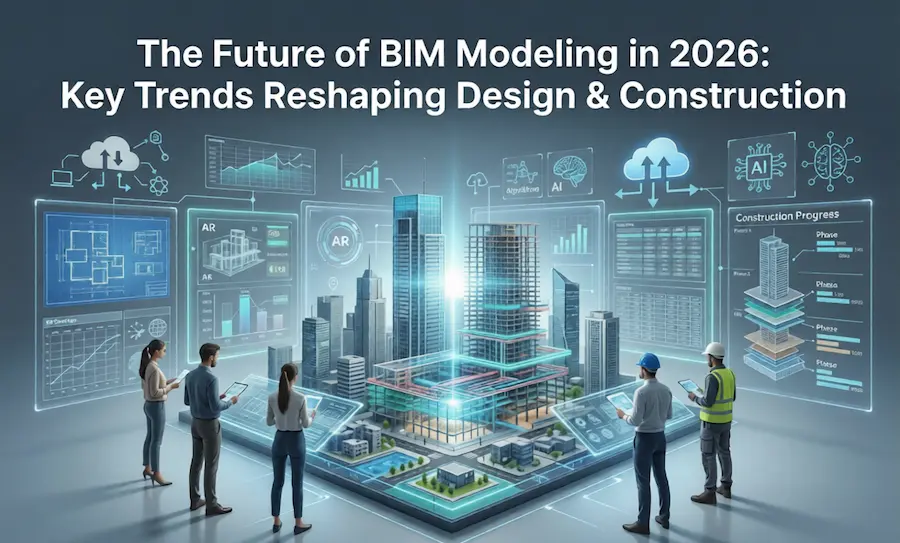
Picture this—a 14-story mixed-use building in downtown Dallas. The structural engineer updates the beam layout on a Tuesday. The MEP consultant doesn’t know. 3 weeks later, when the HVAC contractor submits shop drawings, a duct encounters conflicts with a beam that has moved (a beam that’s already been fabricated). The resulting change order costs $34,000 and pushes the mechanical rough-in by 6 days.
Consider the core issue: The mistake existed in the drawings for three weeks. It was visible to anyone who looked at both sets simultaneously. But nobody did because the workflows didn’t make simultaneous review easy. That’s the specific, costly problem BIM modeling was built to eliminate. And in 2026, the firms using modern BIM modeling services aren’t just avoiding that problem; they’re running projects in an environment where that scenario can be easily avoided.
Do you know the backend game? It’s totally about how BIM modeling trends are changing the way construction projects get designed, coordinated, approved, and built. Let’s get into the depths of these trends.
What Is BIM Modeling in 2026?
BIM modeling in 2026 is a live, data-rich, multi-discipline coordination environment, not just a 3D version of a drawing set. Utilizing comprehensive BIM services ensures a smoother workflow where data flows seamlessly between stakeholders. A current BIM model carries the following:
- Geometry
- Material specifications
- Structural properties
- MEP routing
- Cost data
- Scheduling information
Everything is covered in a single connected file system, which means every discipline works from the same model, and every change propagates across it. This collaborative setup is the key driver behind BIM reducing costly errors during the early stages of a project. And if you are taking BIM as a coordination software, you are 5 years behind. BIM is being developed at a fast pace.
Why is BIM Advancing Day by Day?
BIM is changing to meet the increasing demand of the modern construction era. Construction projects have outgrown the coordination capacity of traditional drawing-based workflows.
In the past, architects first completed design development. Many teams worked in siloed environments, an issue often highlighted in the ongoing AutoCAD vs Revit software debate. Then, drawings went to a structural engineer. After 2 weeks, the structure came back. Next, the MEP consultant received both sets and started routing, yet nobody looked at all three together in the same environment. As a result, the contractor received a bid package and found multiple coordination conflicts during pre-construction. It is where change orders started.
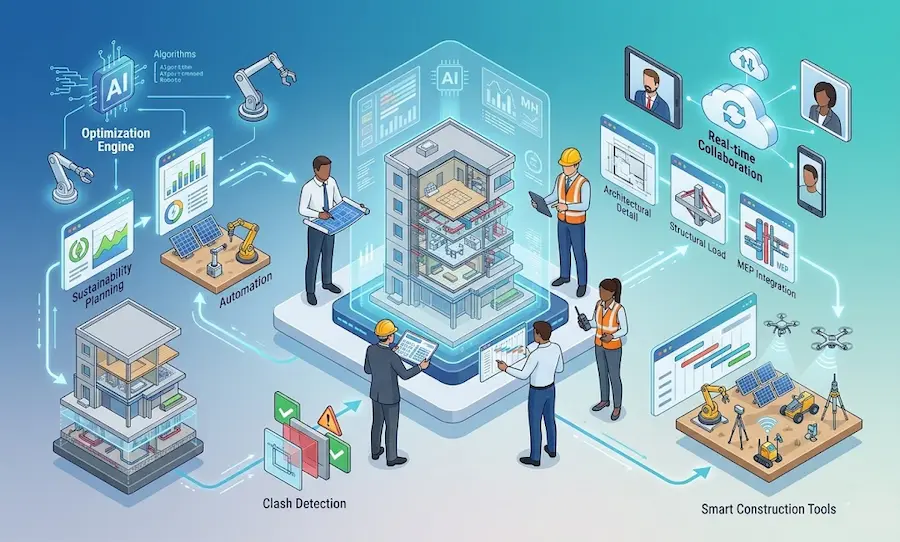
Modern BIM workflows break that chain at every weak link. By integrating advanced construction BIM services, the architect, structural engineer, and MEP consultant all work inside the same cloud-connected model environment. And when everyone is on the same page, conflicts are flagged early, saving time and money.
Traditional Coordination vs Modern BIM Workflows
| Category | Traditional Coordination | Modern BIM Workflow |
| Clash Detection | Manual drawing review, post-bid discovery | Automated, model-based, pre-permit |
| Speed | Sequential disciplines, slow iteration | Parallel workflows, real-time updates |
| Accuracy | Drawing inconsistencies common | A single model source eliminates divergence |
| Collaboration | Email attachments, version confusion | Cloud-synced, always current |
| Revision Handling | Manual redraw, high error risk | Parametric changes propagate across the model |
| Cost Visibility | Estimate separate from design | 5D BIM links cost to geometry |
| Post-Construction Value | Static as-built drawings | Live digital twin for facility operations |
Let’s see what trends are getting into BIM this year!
What are the Key BIM Modeling Trends in 2026?
1. AI-Assisted Coordination
AI tools embedded in BIM platforms have moved well past novelty. In 2026, BIM coordination services use AI to handle clash detection with a level of nuance that manual review misses. It doesn’t just flag hard clashes; it also identifies soft clashes and clearance violations that affect maintainability, code compliance, and field access.
More significantly, AI now applies rule-based filtering to clash reports. On a complex MEP coordination model, raw clash detection can return thousands of results, most of them irrelevant. AI filtering prioritizes clashes by severity, discipline, and location, giving coordinators a manageable working list.
Benefits? Coordination meetings run faster, fewer clashes hit the site, and the time between clash detection and resolution reduces significantly. Specialized engineering tracks like HVAC BIM modeling see the highest efficiency gains. Firms running AI-assisted BIM coordination report 40% to 60% reductions in coordination meeting time compared to manual clash review workflows.
2. Cloud-Based BIM
Cloud BIM is the baseline element of any multi-party project in 2026. Platforms like BIM 360, ACC, and Trimble Connect give every project stakeholder access to the current model state, not a two-week-old model they received by email.
Version control is the hidden benefit here. In traditional workflows, answering “which model is current?” takes significant time and causes big mistakes. Cloud BIM eliminates the question, which means there is only one current model; it’s always timestamped, and every change carries an audit trail back to who made it and when.
For project owners reviewing design progress, cloud access removes the dependency on scheduled presentation meetings. They can open the model at any time and see exactly where the design stands. That transparency changes the approval dynamic, and it’s one reason that submissions on cloud-coordinated projects move faster.
3. Clash Detection and Multi-Discipline Coordination
This is the core value proposition of BIM that other technologies simply don’t replicate. Clash detection occurs in a federated BIM model, an environment where architectural, structural, and MEP models are combined. It catches conflicts that would survive any number of 2D drawing reviews.
The geometry simply does not lie. A duct routing through a beam shows up as a physical intersection in the model. A pipe sleeve that violates fire-rated wall integrity shows up before the wall is framed. And a ceiling height that drops below code minimum in a specific room shows up before the interior finishes are specified.
In 2026, firms running full clash detection workflows on commercial projects are averaging fewer than 4 field RFIs per 10,000 square feet on coordinated building types. And the firms running traditional drawing-based coordination average 3-5x that number.
4. Digital Twins and As-Built BIM
The most significant evolution in BIM in 2026 is what happens after construction. Creating a digital twin, which is a live, data-fed BIM model tied to the completed building, is moving from large institutional projects into mid-size commercial work.
A digital twin isn’t as static as a built model. However, it’s a model connected to building management systems, occupancy sensors, energy metering, and maintenance records. When a chiller fails, the facilities team opens the model provided by their as-built BIM services partner, locates the unit, pulls the equipment specifications, sees the maintenance history, and routes the work order, without hunting through paper files or outdated PDFs.
5. 4D and 5D BIM
Integrating 4D BIM construction scheduling services links model geometry to the project schedule, and 5D BIM adds cost data to that link. Both have become standard practice on large commercial and public sector projects and are moving into mid-size work.
The benefit of 4D BIM: The project schedule is no longer a separate document that someone has to reconcile against the drawings. It’s now embedded in the model. Consequently, the GC can simulate the construction sequence, identify logistical conflicts before mobilization, and show the owner a visual progress narrative rather than a Gantt chart.
Talk to us about your next project and get modern BIM-backed models!
Contact UsThe benefit of 5D BIM: Utilizing 5D BIM services closes the loop between design decisions and cost consequences in real time. When the architect proposes a facade change, the 5D model updates the cost estimate automatically. That conversation, which used to take 2 weeks and involve 3 separate firms, now happens in the same meeting.
6. Outsourced and Scalable BIM Teams
The normalization of outsourced BIM teams is one of the silent structural shifts in the industry. Architecture, engineering, and construction firms have discovered that maintaining a fully staffed BIM department through project cycles is expensive and inflexible.
A GC ramping up on a $40M project doesn’t need to hire 3 BIM coordinators permanently; it needs BIM coordination capacity for 18 months. Outsourced BIM partnerships provide that capacity without the overhead of permanent headcount.
In 2026, with increasing construction labor costs and supply chain volatility affecting project budgets across the board (a direct consequence of ongoing global conflict affecting material shipping routes and raw material pricing), overhead control has moved up the priority list for every firm. Scalable BIM resourcing is one of the places where companies find meaningful efficiency without compromising coordination quality.
7. Sustainable and Performance-Driven BIM
BIM workflows in 2026 are actively informing energy performance, material efficiency, and carbon accounting, not as add-on deliverables, but as integrated outputs of the modeling process.
Energy analysis tools embedded in BIM platforms can test building envelope performance, daylighting scenarios, and mechanical system efficiency directly against the model geometry. A design team can compare 2 facade configurations for both cost and energy performance in the same session. And this is a workflow that used to require a separate energy consultant, a separate model, and a separate fee.
For projects pursuing LEED, WELL, or energy code compliance above minimum standards, BIM-integrated performance analysis is no longer optional. It’s the most efficient path to documentation that satisfies both designers and code reviewers.
What are the 3 Major Benefits of Modern BIM Workflow?
Faster approvals, strong coordination, and consistent documentation.
Faster Approvals
Approvals move faster when reviewers work with fully coordinated, clash-free model submissions. Municipal plan reviewers in several major U.S. markets now prioritize BIM-integrated permit submissions because they’re easier to evaluate and generate fewer back-and-forth correction cycles.
Quality Coordination
Coordination quality improves when every discipline references the same live model. A structural engineer updating a connection detail, say at 9 PM, can flag it in the cloud model, and the MEP coordinator sees it, say by Wednesday morning, not two weeks later after a drawing distribution cycle.
Consistent Documentation
Documentation stays consistent because the model produces the drawings, not the other way around. When the geometry updates, the affected plans, sections, and details update with it. Drawing inconsistency, which is one of the most common RFI sources on traditionally produced drawing sets, is structurally eliminated.
What Challenges Can You Face in BIM Adoption?
Coordination Workflow Gap
Teams that implement BIM but continue to treat it as a drawing production tool, rather than a coordination environment, miss most of the value. BIM coordination requires active cross-discipline model sharing, regular clash review meetings, and a defined process for how conflicts get resolved and documented.
Interoperability Issues
Software discrepancies between platforms create friction on multi-firm projects. An architect on Revit, a structural engineer on Tekla, and an MEP consultant on AutoCAD MEP all produce models in different formats. Without a defined IFC export protocol and a federated model environment, BIM coordination becomes a theoretical concept rather than a working practice.

Training Gap
When project managers don’t understand what BIM coordination can and can’t catch, they don’t use it correctly. They either over-rely on the model and skip other QA steps, or they underuse it and wonder why they’re still getting field RFIs.
Model Fidelity Standards
These standards vary widely between companies. A Level of Development 200 model and an LOD 350 model look similar to a non-specialist, but their coordination value is dramatically different. Without clearly defined LOD requirements in the project BIM execution plan, different parties produce models at different fidelities, and clash detection produces misleading results.
How to Deal With Modern-BIM Workflow Adoption Challenges?
- Invest in cross-firm BIM execution planning at project start.
- Define interoperability protocols before modeling begins.
- Train project managers alongside drafters.
- Partner with BIM teams that have a demonstrated process, not just software access.
Conclusion
BIM modeling in 2026 isn’t a design tool; it’s a project delivery infrastructure. The firms treating it that way are winning bids, reducing change orders, closing out projects faster, and handing owners something that has value for the life of the building. And the groups that haven’t made the transition are still finding beam conflicts in the field.
The technology is mature. The outsourcing infrastructure is in place. The ownership demand is growing. What’s left is execution, and right execution. It is where BIM Modeling helps with its trusted services for designers, engineers, and contractors.
Frequently Asked Questions
What is the difference between BIM and CAD?
CAD produces technical drawings, which means 2D plans, sections, elevations, and details. BIM creates an intelligent model that carries those drawings plus material specifications, structural data, MEP system information, cost data, and scheduling links.
What is a BIM execution plan?
A BIM execution plan (BEP) is a project-specific document that defines modeling standards, LOD requirements, coordination protocols, software platforms, file sharing methods, and clash review schedules for all project parties. It’s the operational framework that makes multi-firm BIM coordination actually work.
Can BIM reduce construction costs?
Yes, through clash detection that eliminates field-discovered conflicts, and through 5D integration that links design decisions to cost in real time.
What should owners require in a BIM deliverable?
- A federated coordination model
- A clash detection report with a resolution log
- Discipline-specific LOD 350 models for MEP and structure
An LOD 400 as-built model suitable for digital twin integration
