

Consider a situation. You are a contractor who just won a commercial renovation project.
Your laborers have already poured concrete right on time. But when subcontractors take on their job, like the installation of walls, problems start popping up. Piping and electrical elements are clashing with one another.
What will you do next? Obviously calls for change orders, which will take both time and money. This time, you have to go with change orders for all fixes. But for the next time, be focused when you are in the designing phase.
BIM modeling, which has become AI-powered now, plays an important role in this whole game of construction. While AI-driven modeling delivers powerful results across the entire construction industry, it brings especially transformative benefits to interior architecture. Interior architects and designers now use intelligent BIM models to coordinate complex layouts, systems integration, and sustainable design decisions with unmatched precision. Let’s explore this topic in depth!
The Rise of AI in Interior Architecture
The rise of AI in interior architecture is bringing new possibilities for you. Today, you can handle complex layouts with greater confidence. Similarly, you can verify that your project models incorporate functional requirements seamlessly, ensuring that spaces perform better for end users long-term.
Moreover, interior architecture projects benefit from early validation now; however, uncertainty was a common issue, particularly for complex projects, before. Simply put, AI simplifies the entire designing process for you.
What is Interior Architecture?
It focuses on the structural and functional backbone of spaces. In this, teams design load-bearing elements and systems integration carefully while making sure that the buildings adapt over time successfully.
Remember that interior architecture goes beyond surface finishes alone. However, many confuse it with pure aesthetics. Therefore, interior architecture ensures longevity and performance.
Interior Architecture Vs Interior Design
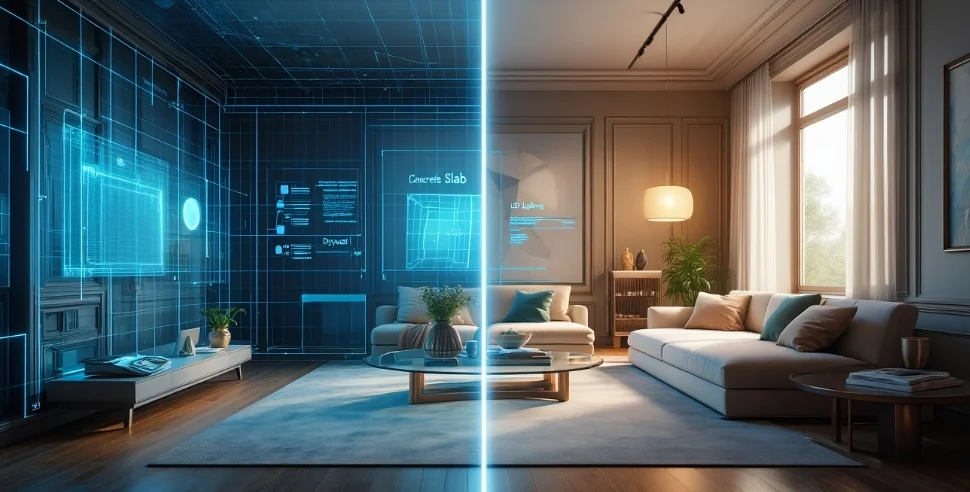
You must know the difference between interior architecture and interior design. Interior architecture shapes the core structure and systems, focusing on functionality and durability of the project. However, interior design emphasizes aesthetics and furnishings of the project and hence comes after architecture. Read more on interior design using our guide: What is interior design: 10 popular styles every designer should know.
This shows that both roles complement each other perfectly. You must have a clear understanding of the scope to avoid. In the results, your project will flow more smoothly from concept to completion.
Principles of Interior Architecture
The principles of interior architecture, balance, rhythm, focal point, scale & proportions, harmony & unity, ergonomics & functionality, and sustainability, guide every decision. AI-powered modeling now helps interior architects apply these principles faster and more accurately than ever before.
Considering them, you can prioritize spatial flow and structural integrity. Furthermore, sustainability remains central to your choices, so that the spaces feel intuitive and efficient. Besides, these principles align perfectly with AI tools; however, manual processes often overlook them. Therefore, AI reinforces these core ideas effectively.
AI-Powered Sustainable Interior Architecture Designing
The sustainable interior architecture design process gains power from AI. Using both at one time, you can optimize material selections automatically, ensuring reduced waste and improved performance of the project. Moreover, it offers energy modeling in real time as well as suggests greener alternatives instantly.
Remember that manual calculations slow progress significantly, but AI accelerates truly sustainable results for you.
With a clear understanding of interior architecture and its core principles, let’s now examine the common pain points that traditional design processes still create, and how AI-driven modeling solves them specifically for interior architecture projects.
Common Pain Points in Traditional Design Processes
Before we move to AI-powered modeling, understand the issues in the traditional methods.
Traditional methods created constant headaches as you had to rely on manual drawings that missed many hidden conflicts. When estimators used the wrong drawings, they guessed inaccurate quantities; consequently, contractors and builders faced financial surprises later on the site. This ultimately reduces the contractors’ profit, and side by side, they waste a lot of time.
The whole project experiences communication issues, project coordination problems, conflicts between team members, inaccurate materials orders and a shortage of labor/labor sitting idle. All these issues combine, and you see them in the form of waste of money and time.
While these problems affect the wider construction industry, they hit interior architecture projects particularly hard because of their complex system integration and tight spatial constraints.
How Does AI-Driven Modeling Work in Construction Today?
AI-driven modeling processes vast data sets instantly for you. When you feed it existing plans and recent site scans, the algorithms predict outcomes with the highest possible accuracy.
Additionally, the system runs thousands of simulations at the same time. Consequently, you receive optimized designs earlier than a human can.
Like experts providing interior BIM modeling services, you can also integrate AI directly with your BIM platforms. This way, models will update automatically whenever changes occur. This makes sure that you avoid outdated information completely from now on.
Above all, the tool flags inconsistencies before anyone notices them.
Note: Explore more on BIM by reading our guide: What Is BIM in Architecture? A Complete Guide for Architects.
How AI-Driven Modeling Delivers Measurable Benefits for Interior Architecture Projects
AI-driven modeling solves the biggest challenges in traditional design by delivering clear, measurable improvements tailored specifically for interior architecture projects.
● Reducing Costly Errors & Rework
AI instantly identifies clashes between piping, electrical systems, walls, and other elements before construction begins. Subcontractors can install everything correctly on the first attempt, dramatically cutting change orders and expensive on-site fixes.
See how AI-driven modeling improves design accuracy and ROI today.
Contact Us● Improving Project ROI
Precise quantity calculations reduce material waste, while faster design delivery leads to earlier project completion and occupancy revenue. Clients are impressed with the results and return for future work, steadily lifting your bottom line.
● Making Construction Estimates Precise & Accurate
Estimators generate automatic quantity takeoffs with no guesswork. When design changes occur, figures update instantly. The system also predicts material and labor cost fluctuations, allowing you to submit competitive bids with full confidence.
● Enhancing Design Accuracy
Smart algorithms catch tiny dimensional errors early, compare multiple design options side by side, and learn from previous interior architecture projects. This results in models that align perfectly with real-world conditions and improve with every new job.
Beyond the general benefits for construction, AI-driven modeling delivers even more targeted advantages when applied directly to interior architecture modeling.
The Role of AI in Interior Architecture Modeling
● AI Streamlining Collaboration Among Teams
AI enables teams to share live models with everyone involved in a construction project. This way, feedback plus solutions come in real time. Moreover, changes propagate instantly across disciplines. However, email chains are used to create a mess. Therefore, AI keeps everyone aligned perfectly, enabling you to experience smoother outcomes.
● AI Optimizing Construction Materials
Material optimization through intelligent modeling saves significant money. You can test alternatives before ordering anything. The system also flags overages instantly. This way, procurement stays streamlined and efficient.
Besides, sustainable choices integrate naturally, eliminating the need for guesswork that leads to excess inventory. Therefore, AI keeps your costs under control while optimizing materials for your projects.
● Clash Detection in AI-Powered Models
You know that clash detection prevents site disasters, and this is what you can achieve using AI-powered models. You can run scans daily instead of weekly; this will resolve issues before they appear. Moreover, you can ensure that all the trades involved are going parallel. So, this way, AI-powered models make your project an ultimate success.
● AI Connecting Modeling to Real-World Site Data
You know how connecting modeling to real-world site data improves accuracy. This is something that you can do with AI. You scan existing conditions and feed them in, making models reflect reality perfectly. Furthermore, you can automatically compare as-built models, reducing the chances of missing points in the plans, and hence streamlining steps ahead.
● AI Speeding Up Design Iteration Cycles
Every contractor and builder wants to speed up design iteration cycles, as it changes project timelines. With AI, you can test variations in hours instead of weeks, tightening feedback loops. This means that your clients will see options sooner (more chances to rely on you due to speed).
No need to worry about the quality because speed never damages the quality of data when you rely on AI. Simply put, AI keeps projects moving forward smoothly.
● Improving Client Presentations with AI
With AI, you can improve presentations to be presented to your clients. This approach will help you show realistic walkthroughs early in the process, making approvals hassle-free and faster. Furthermore, you can avoid changes that cost significantly in the construction world. So, this way, AI makes communication crystal clear.
● AI Helping Track ROI Improvements Over Time
With AI, you can compare project data side by side, making patterns emerge quickly. Also, you can refine processes based on results, not guesses. Therefore, we can say that AI provides objective insights.
Challenges in Adopting AI-Powered Modeling
There are many challenges you can face while adopting AI in modeling. These can include:
- Data issue
- Skill gap
- Integration with the legacy system
- Higher cost & ROI uncertainty
- Cultural resistance
- Change management
- Ethical concerns
How to Avoid Challenges in Adopting AI-Powered Modeling?
- Invest time upfront in training your team properly.
- Establish data governance
- Build a talent pipeline
- Focus on scalability
- Plan for change management
Future of AI in Architecture and Interior Design
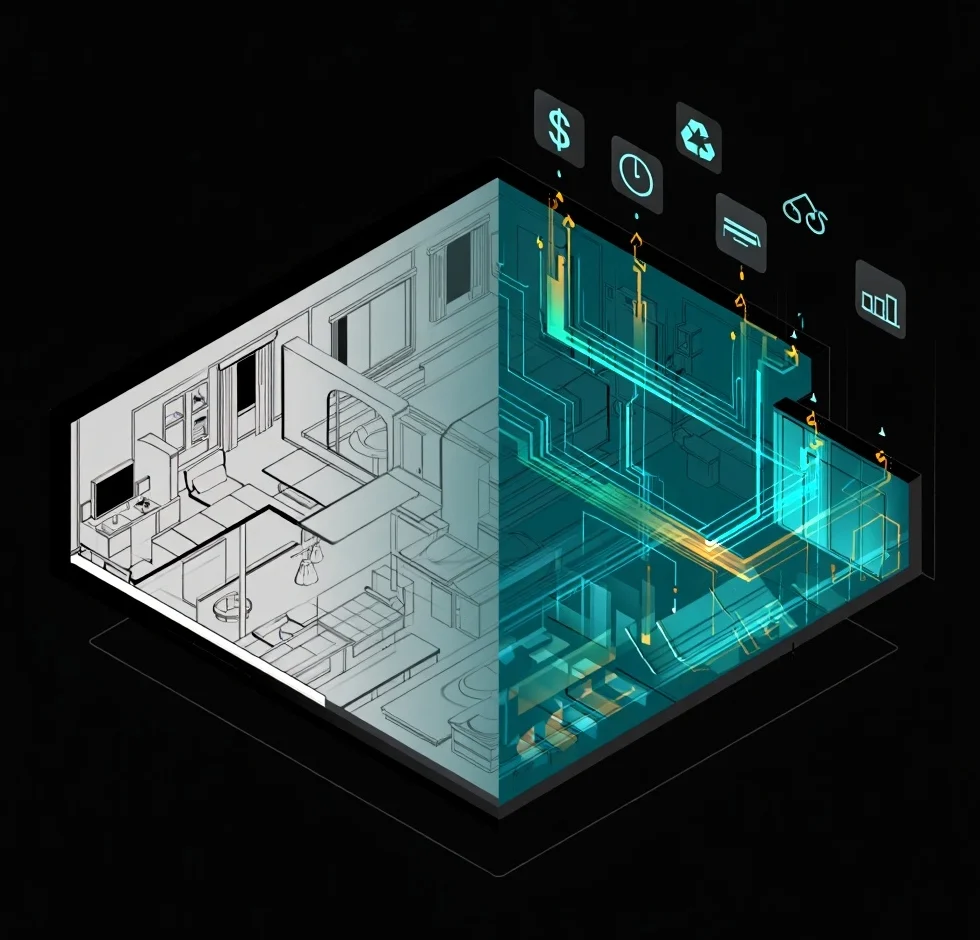
No doubt, it looks bright. You will predict maintenance needs years ahead. Generative options will multiply rapidly, ensuring that creativity meets efficiency perfectly. Likewise, architecture and interior design teams will collaborate closer than ever.
Note: Human judgment remains essential. Therefore, you must always verify what you get from AI. This will ensure better quality.
Conclusion
AI-driven modeling catches errors early and reduces rework dramatically. Using AI in modeling, you can achieve sharper estimating through automatic quantity takeoffs, gain functional precision and sustainable outcomes, experience ROI climbs since costs stay controlled, and schedules compress.
Remember that the project’s success requires smart integration with your existing BIM workflows. Whether you are a contractor, interior architect, or design-build firm, the results are the same: fewer errors, higher ROI, and better-performing spaces. Therefore, you must adapt these tools to finish stronger and win more bids.
We at BIM Modeling help contractors, builders, architects, and estimators implement AI-driven modeling every day. Our BIM modeling services combine expert BIM workflows with intelligent automation, ensuring that you get accurate models for precise takeoffs and measurable ROI.
Let us handle the heavy lifting so you can focus on building. Contact us today and transform your next project with our assistance now!
Common Questions Asked
How does AI improve accuracy in construction models?
AI improves accuracy in construction models by running continuous checks. You can catch dimensional errors before they reach the field, which drops rework on every project. Moreover, the system learns from your past data. Therefore, precision increases with each new model you build.
Can small contractors afford AI-driven tools?
Small contractors can afford AI-driven tools through cloud platforms. They can pay only for what they use monthly. This way, upfront costs stay manageable. In addition, time savings offset subscription fees quickly. For the safe side, you can start with basic features first.
How does interior architecture benefit from AI modeling?
Interior architecture benefits from AI modeling through better system coordination. Today, teams test layouts for functionality early, ensuring that the spaces perform better long-term. Also, sustainable options integrate seamlessly. Therefore, projects achieve higher performance standards with AI.
What role does BIM play with AI?
BIM plays a central role with AI by providing structured data to designers. Using them, you can feed accurate information into algorithms, and consequently, get reliable results fast.
