
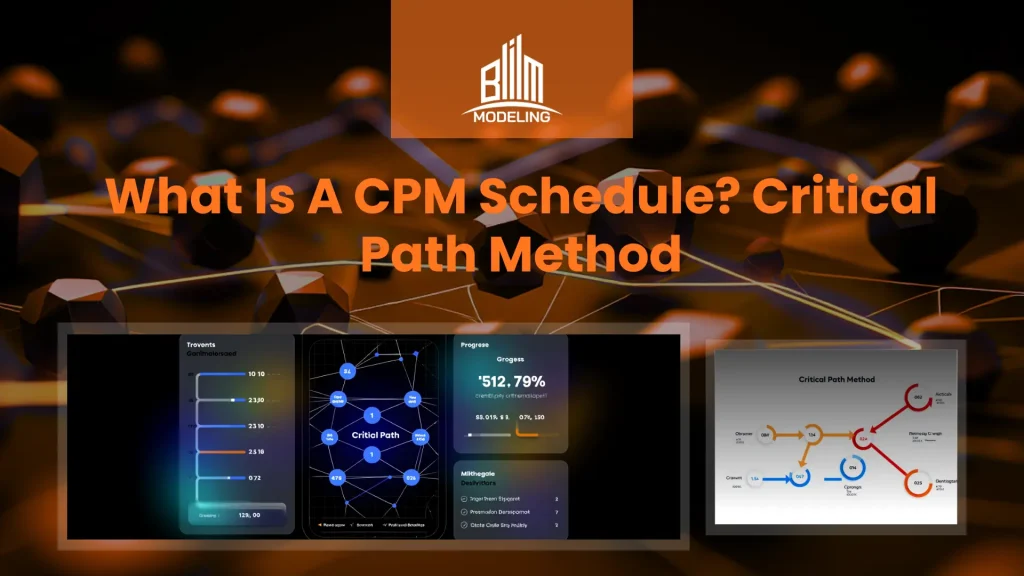
The goal of every construction project is to complete it within the timeline, which is why insightful scheduling is so important. For this, the CPM schedule is the best technique that helps to organize and handle critical construction activities within a consistent order and timeline, avoiding rework and delays. Also, this allows managers to monitor the process and detect various errors immediately if they occur, to avoid them. As a contractor or project manager, you should consider the project’s critical path methodology to prevent construction work from being delayed. This not only increases your ROI but also your reputation.
Further, the critical path method helps stakeholders identify the most important tasks. It also balances between time and project quality. For example, the project may take longer to complete than anticipated if you take longer than necessary to complete important tasks. To complete jobs in an accurate time, CPM also helps engineers and contractors make decisions fast and adjust to new developments to avoid delays and rework.
Let’s explore CPM and its benefits in detail.
What Is A CPM Schedule?
CPM is a method that provides information about which construction tasks require more time and more attention to deliver the project within the timeline. It helps to improve planning while maintaining quality and reliability.
CPM plays a particularly important role in complex and large projects where cost and time are of the essence. It is a mathematically based scheduling system that introduced network diagrams and logical activity sequencing. With this method, you not only build strong collaboration but also remain satisfied with the construction process.
Whether it is industrial projects or commercial, managers demand the CPM method for scheduling. It is the best way to plan a project and monitor it later. Additionally, you can have the ability to control time, money, and quality. All things considered, we can say that CPM is essential to reduce delays and guarantee the timely completion of the project.
Key Components Of CPM
Let’s dive into the details of the key components to understand how it works.
1. Activities and Tasks
When you start scheduling using the Critical Path Method, activities are ranked based on various factors such as details, resources, and duration. These are explained in great depth so that project owners can easily know which tasks and activities should be prioritized first. This not just improve monitoring and construction efficiency but also saves you from inaccurate schedules and unexpected delays.
2 . Duration
It is very important to accurately analyze the duration of each activity because the overall scheduling depends on it. If you misjudge the time, the project can face time loss and delays. That is why experts carefully explain step by step how many days, weeks, and months are required for the installation of the plumbing system, the duration of the foundation construction, and the internal work. So that contractors can schedule the work with confidence and without errors. Besides CPM, 4D BIM scheduling is also helpful to manage the time by linking the timeline with the project’s tasks. To know 4D BIM scheduling and its benefits in detail, you can read our blog “What is 4D BIM and how does linking schedule data to models reduce delays?”
3. Network Diagram
Network diagrams are a key part of CPM, showing the activities and tasks from start to finish of projects on a single page with arrows and explanations. Through these clear images, project managers and contractors identify the sequence of tasks that help meet timelines without compromising quality and avoiding conflicts. This enables stakeholders to make construction smoother and faster.
4. Float
There are some rules for a smooth and sequential construction process. For example, some activities cannot start until specific tasks are completed, while other activities can start while the same discipline is in progress. This strategy prevents not only rework but also additional costs. Furthermore, if dependencies are properly defined, the project plan will faithfully replicate the boundaries and workflows seen in the real world.

Benefits Of CPM Schedules
When you choose the CPM for scheduling, you can see significantly better changes in project management and construction processes. Let’s see what benefits stakeholders get.
● Beat Project Control
CPM schedules organize tasks logically, which helps managers understand the importance and scope of the work. This not only assists in organizing the planning process within the budget but also helps in controlling the overall process and ensuring timely delivery. When engineers and workers follow the CPM schedule, they avoid conflicts, delays, and mismanagement.
● Identify Key Tasks
A key advantage of CPM is that project owners can identify essential tasks that must be completed early to meet the timeline. For this, the critical path method plays a key role and enables the project team to prioritize and closely monitor critical tasks to avoid delays, rather than allocating resources equally across all operations.
● Improve Time Management
A timeline detailing the history of each construction step, including structural, architectural, and MEP, is provided through the critical path technique. It also emphasizes float work so that the team can focus on critical tasks without wasting time on unimportant tasks. Additionally, through CPM, managers can detect potential risks promptly to prevent delays and to increase productivity and efficiency.
● Reduce Risk
With CPM, you can identify risks and address them in a timely manner to avoid project rework that causes delays and budget overruns. This helps bring clarity and accuracy to the schedules before work begins. It also reduces the chances of unforeseen circumstances and boosts the stakeholders’ confidence.
Drawbacks Of CPM
While CPM has many advantages, it also has some limitations that project managers and contractors must understand in order to use CPM schedules correctly.
Accuracy Is Correlated With Time Estimates
The accuracy of CPM depends entirely on the estimation of activity duration. This means that incorrect predictions can lead to unrealistic project schedules and a distorted critical path. In addition, it is very important to accommodate new changes in the schedule, as it can not only cause delays in project delivery but also cause clients to be dissatisfied with your services.
Not Suitable For Uncertain Projects
For projects that change periodically due to design and other requirements, CPM is not a suitable method for creating a schedule. Also, in such projects, changes occur without warning and without accepting dependencies. Therefore, agile-based schedules are more suitable for management than CPM. However, BIM is very helpful for uncertain projects due to real-time clash detection and data management. You can also read our blog on “What is BIM? A complete guide to Building Information Modeling?
Complicated For Large Projects
Typically, large projects have more than hundreds of activities and tasks where CPM does not work well. Because in this situation, it is difficult to create, manage, and revise CPM scheduling. In particular, when small changes occur, it not only disrupts the duration of a single task but also can affect multiple construction activities.
Need Help Creating an Accurate CPM Schedule? Contact Our Experts Today!
Contact UsTools And Software For CPM Scheduling
OpenPlan
In complex infrastructures, this tool plays a crucial role. It not only analyzes risks but also improves scheduling and project management.
Microsoft Project
The Microsoft Project tool is suitable for scheduling in small-scale projects. It provides users with charts that mention all the details like tasks, their durations, and dependencies.
Primavera P6
It is used for engineering and large-scale construction to transform complex activities into simple scheduling. It enables managers to control and monitor the construction process.
If you want to proceed with BIM and need to know BIM software, you can explore them in our detailed blog “ Top 15 best BIM software you need to know in 2026”.
Conclusions
Critical path scheduling is a technique that is widely used in the construction industry for project planning and executing more efficiently without errors. This tool prioritizes activities to focus on the most important tasks first. It also identifies risks, resolves them, and improves resource allocation to ensure smooth construction and timely delivery. Furthermore, the CPM schedule is a robust decision-making tool as it is built with modern tools and updated with real project data. Overall, this tool increases project visibility, reduces the chances of delays, and improves ROI.
FAQs
Why is the Critical Path Method important for project scheduling?
CPM is a popular tool for scheduling because this help identify the most critical tasks, optimize resource allocation, and monitor the construction process to support meeting the timeline without sacrificing quality.
Is there any difference between CPM and a Gantt chart?
CPM categorizes tasks as per their importance and dependencies, while Gantt charts represent the project schedule in bars along with a timetable.
Is CPM scheduling best for residential projects?
Yes, the critical path is important for residential projects. This helps in the construction of the structure, architecture, and MEP without wasting time. It also strengthens the collaboration and improves the reliability of the project.
What mistakes do most managers make in CPM scheduling?
Managers make some mistakes, such as incorrectly estimating duration and not regularly checking the schedule, which causes inefficiency in CPM scheduling.
Which software is best for CPM scheduling?
The choice of software for CPM scheduling is important depending on the type and complexity of the project. But Primavera P6 and Microsoft Project are widely used in the construction industry.
