

Nowadays, construction industries use Building Information Model (BIM) to avoid any kind of errors and losses. It is not just a tool, but there is a complete story behind its processing. BIM models are generated and then lead towards BEP. The BEP is a process of implementing BIM, software, technical solutions, and project requirements in construction to deliver outcomes that clients want. It also helps the construction team to understand their responsibilities and duties. So that everyone can work smoothly while being on the same page.
BIM prevents rework and additional costs. The process starts with early planning and gathering comprehensive project information, then BEP streamlines construction. In this blog, we’ll explore how BEP experts work to transform 3D visualization designs into accurate BIM. Are you excited to dive into the details? Let’s do it.
What Is A BIM Execution Plan (BEP)?
BEPs are documents that define the purpose of BIM, the level of detail of information, and the use of methodologies for engineers, designers, and contractors. This eliminates confusion and misunderstandings among members and strengthens coordination.
It’s not just a document. It is like a roadmap that guides structural and MEP engineers to execute within BIM design correctly. Otherwise, the project may have errors and rework. Furthermore, the BEP should be developed and implemented during construction to ensure that everything goes according to plan and without any disturbance.
The Role Of BEPs In BIM Application
BEP is a critical part of BIM because without it, BIM is ineffective and cannot fulfill the purpose of the project. For example, a BIM information modeling generates a 2D design of an electrical system. Still, BEP helps engineers know when and how to follow the models without conflicts and waste of material.
It also keeps a check on conflicts, construction sequences, and procurement systems to control budgets and ensure smooth execution. It enables the team to resolve conflicts at any stage. This helps you avoid delays, rework, and wrong decisions.
Deliverables Of BEPs
- BIM goals and objectives
- Names and uses of software required
- Assigns project stakeholders tasks
- Schedules and deliverable timeline
- Minimizes rework and maximizes efficiency
- Exchanging requirements and modeling roles

Key Benefits Of Using BIM Execution Plans
When you use authentic BEPs in construction, you can see a clear difference in terms of benefits. Here we discussed some of the following.
Improve Collaboration
BEP enables engineers, fabricators, contractors, and designers to work on the same page and with strong communication. It prioritizes using a sharing platform to send building information modeling to ensure that everyone is working on the same design promptly. The tool also keeps the team informed of new changes and regulations, so the construction process can adapt to them quickly to avoid rework.
Reduced Errors And Rework
The main reason for rework is when the team builds with inadequate guidance and modeling. It is crucial to ensure that the material installation procedures meet the project specifications, site requirements, and local codes. For this, BEP helps. It approves information, assigns responsibilities to engineers, detects conflicts on time, and controls quality. These all prevented costly mistakes and rework.
Enhance Efficiency And Productivity
One of the primary uses of BEP is that you can increase project productivity by working faster and maintaining quality. How this works:
| Efficiency Driver | Impact of BEP |
| Standardized Naming | Reduces time spent searching for files by up to 15%. |
| Clear LOD (Level of Dev) | Prevents “Over-modeling,” ensuring engineers don’t waste time on unnecessary detail. |
| Automated QC | Allows for automated software scripts to check for errors based on BEP rules. |
Time And Cost Savings
The team building mostly causes rework without proper modelling or guidance. Ensuring that the material installation techniques adhere to local codes, site restrictions, and project specifications is crucial. BEP aids in this. It approves data, delegates tasks to engineers, quickly identifies conflicts, and maintains quality control.
The Strategic Alignment Table
You have to see how BEP aligns the interests of multiple parties to truly understand its importance truly.
| Stakeholder | Primary BEP Value |
| The Owner | Ensures the final digital asset is usable for Facility Management (FM). |
| The Architect | Protects design intent and clarifies the scope of digital deliverables. |
| The Contractor | Reduces field rework and provides accurate quantities for procurement. |
| The Sub-Contractors | Provides clear instructions on how to integrate their fabrication models. |
What Elements Are Inside The BIM Execution Plans?
Perfect BEPs consist of key components that have a specific purpose. Let’s study them in detail.
Projects Details
This section is designed to help the team understand the project details and information. It shows the project owner’s name, location, construction type, and completion date. It is used not only in BIM but also in the design stages. It also helps to stakeholders in building without any confusion.
BIM Uses
‘Using BIM’ is an important section because its proper use brings buildings within the regulations, client needs, and market demands. In this section, you will find energy analysis, quantity take-off, clash detection, and design intent. All of these support using models in the structural, architectural, and MEP systems within the budget and maintaining the project goals. It also improves project execution and ROI.
Roles And Responsibilities
BEPs also outline the duties of coordinators, engineers, designers, and modelers so that they understand their duties and are on the same page. This increases collaboration while also eliminating the potential for conflicts and miscommunication. It is also beneficial to install each component correctly and avoid conflicts with other disciplines.
Model Update Frequency
Running a successful construction process requires regularly reviewing models and adding new information to BIMs. If you don’t, it can lead to poor results and costly rework. To avoid all the pitfalls associated with this, you can update BIMs by conducting weekly or monthly model reviews. This makes it easier to ensure that everyone is following specifications and working on the same design.
LOD Requirements
The level of development helps the modeler to prevent under- and over-modeling. It also improves the reliability and decision-making ability of the models.
| LOD Level | Definition | Example: Structural Column |
| LOD 100 | Conceptual | A vertical line representing a column. |
| LOD 200 | Approximate | A rectangular shape with approximate dimensions. |
| LOD 300 | Precise | Exact size, material grade, and location. |
| LOD 350 | Coordination | Column + connection plates and rebar clearance. |
| LOD 400 | Fabrication | Shop-drawing level detail; ready for manufacturing. |
Types Of BEP
There are 2 types of BEP
- Pre-contract BEP
- Post-contract BEP.
Both differ from each other due to their goals and degrees of detail. We have explained their goals and functions below.
Pre-Contract BIM Execution Plan
The Pre-Construction BEP is used in the bidding process to demonstrate the ability to use BIM, meet regulations, and demonstrate expertise in custom design. It also highlights the ability to use software, risk management, and collaborative processes. With it, you can maximize your chances of winning a project.
Post-Contract BIM Execution Plan
A post-construction BEP is created when the contractor or engineer wins the bid. It details how BIM, project information, client responsibilities, clash detection processes, software name, and file format will be implemented. It helps to install each component on site within the regulations and project goals.
The Difference Between Them
Here is the table that shows their differences in a simple context.
| Feature | Pre-Contract BEP | Post-Contract BEP |
| Created By | Lead Proposer/Tenderer | Lead Contributor + Appointed Parties |
| Level of Detail | Strategic/Generic | Tactical/Specific |
| Timeline | Bid Stage | Project Kickoff onwards |
| Legal Status | Statement of Capability | Contractually Binding Document |
| Primary Goal | To win the work | To execute the work |
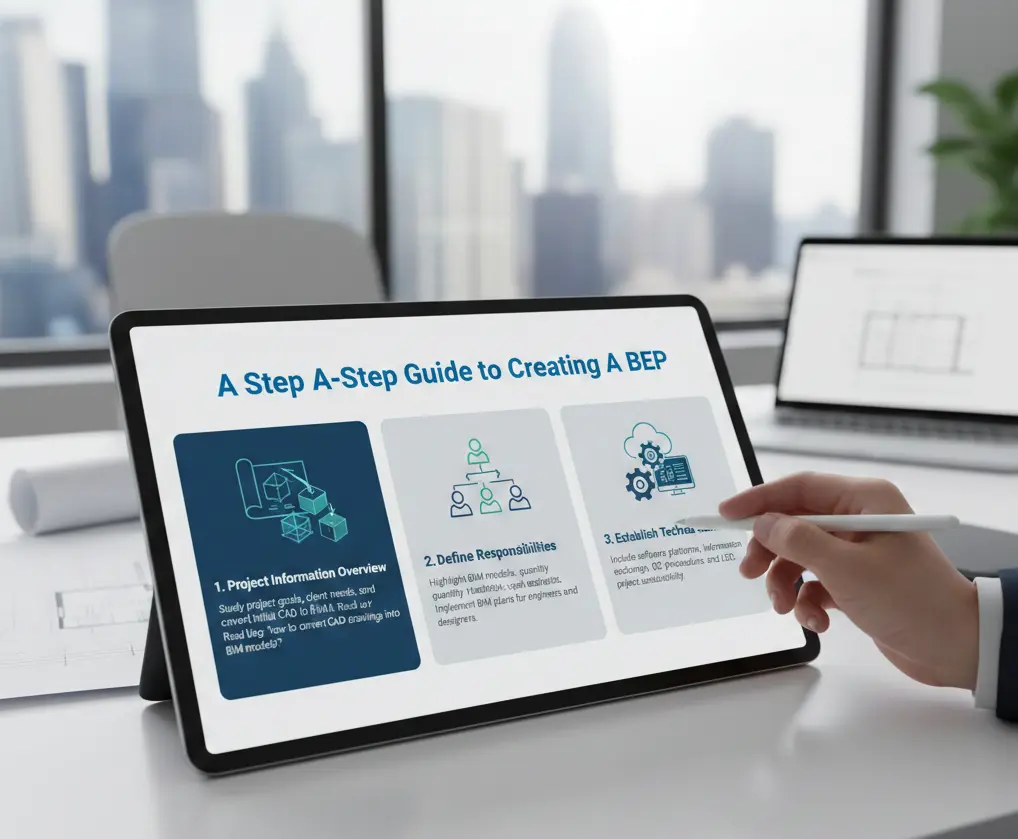
A Step-by-Step Guide to Creating A BEP
The following is a step-by-step process to create an authentic BEP
Project Information Overview
The BEP should be within the project goals and requirements. Therefore, start by studying the project information. This helps you understand the project objectives, the client’s needs related to BIM, and why they need BIM. Through this, you can plan the BIM implementation according to the client’s expected results. To start this, initial CAD drawings are required, which are converted into BIM models.
To know the best methods of conversion, you can read our blog: how to convert CAD drawings into BIM models?
Define Responsibilities
The next step is to highlight BIM information such as models, quantity takeoffs, solutions, and cost estimates. Knowing the information is not enough; using it correctly is the key. For this, BIM implementation plans help engineers and designers determine their duties and guide them on how to apply 3D models to construction work without any errors.
Establish Technical Standards
All technical information about the projects, including software platforms, information exchange, quality control procedures, and level of development, should be included in a section of the BEP. This increases the sustainability, dependability, and results of the project.
Final Review
Finally, BEP creators meet with engineers and contractors to review the plan to ensure they agree and are satisfied with it. In addition, BEPs are updated during regular review processes and when changes occur to maintain project goals, design intent, and quality. BIM implementation plans improve risk management and successful delivery.
Best Practices For BEP Excellence
A well-planned BEP is only possible with best practises. Do you want to know what elements are important for practical and effective BEPs? We have explained below.
- The BEP should clearly define the project’s purpose in terms of coordination, cost, and schedule. It also ensures the best results in line with the project’s goals.
- The best BEP meets regulatory codes that improve feasibility and project safety.
- The Excellence BIM implementation plan clearly outlines each member’s responsibilities without confusion. This enables the team to plan and build with confidence.
- To create a reliable BEP, it should be clear which model each team uses, which helps you stay on track and avoid rework.
- An effective BEP makes communication transparent and eliminates conflicts and misunderstandings.
What Challenges Arise During BEP Implementation, And How To Overcome?
When many businesses collaborate, it is common to encounter difficulties. Resolving them quickly is crucial. We have discussed the challenges that BIM modellers may face, and best practises to address them.
Unclear BIM Goals
If you start installing the structure, architecture, and MEP components without considering the project goals and requirements, the effort can be wasted, and satisfactory results cannot be achieved. To get the desired building outcome, you must develop BIM implementation plans that are consistent with the project’s objectives and expected deliverables.
Insufficient Quality Control
Neglecting quality control during BEP can lead to errors, disputes, and design conflicts, which are the cause of delays and rework. For a smooth and error-free implementation, you should plan regular meetings to review the quality of the project and make any necessary modifications. This protects you from several risks.
Over-Modeling In BIM
Over-modeling in BIM creates unnecessary file sizes, wastes time, and makes BEP processes unsatisfactory. In order to build at the desired LOD while following BIM implementation plans, it is crucial to define model standards and LOD for every building system in BEP. This improves coordination and project efficiency.
Some other challenges are given below.
| Common Challenge | Impact | Strategic Solution |
| Lack of Training | Poor data entry and model errors | Budget for 4-hour “BEP Onboarding” for all leads |
| Software Version Conflict | Data corruption/loss | Contractually mandate a specific software version |
| Silent Silos | Unresolved clashes in the field | Mandatory weekly “Live Coordination” sessions |
How BEPs Are Evolving In Modern BIM Projects?
In today’s modern and complex construction industry, BEPs play a critical role in achieving success.
CDE Integration
CDE helps organize project information and align it with BIM, so construction can be done according to project goals and objectives. When BIM reflects all information, then collaboration is strengthened at every stage. It also reduces errors, conflicts, and rework.
Clear Responsibilities
Clearly defining responsibilities for engineers and contractors is essential to avoid confusion, rework, and delays. That’s why stakeholders use BEPs that also improve project reliability, engineers’ decision-making ability, and project execution.
4D And 5D Support
BEPs are also in demand because of their ability to manage costs and schedules. BIM implementations help projects to be built without wasting materials and overspending. It also prevents project delays and rework to keep you on track.
Explore BIM Execution Plans
Contact UsLegalities, Security, and Smart Integration
BIM models should be code-compliant and secure from digital threats and data loss. For this, some of the latest advancements are very helpful. Let’s discuss them one by one.
Data Ownership & IP Rights
Data ownership and intellectual property (IP) rights are like a roadmap that shows who owns the models and information and how they will be used. It also defines software-generated outputs and property workflows in the early stages that avoid conflicts and make the project lifecycle efficient.
Digital Twin Security
A digital twin is a replica of a project’s assets and information that also needs to be protected. Cybersecurity plays a key role in protecting the twin documents from unauthorized access and possible sabotage. This will not only improve operational processes but also prolong the partnership between members.
IoT-Enabled Buildings
Sensors and connected devices are used in IoT-enabled buildings to increase operational efficiency and save energy. Integrating IoT with BIM has made it easier to obtain real-time data from HVAC systems, lighting, and other building components for renovations and project lifecycle management. Furthermore, it increases the sustainability and efficiency of buildings.
You can read the comprehensive information about the integration of sensor data into BIM models in our blog how to add IOT sensor data to BIM models?
Beyond Traditional Handover
Nowadays, delivering documents in accessible formats such as PDFs is increasingly being used. This helps facility managers control operations and assess efficiency and performance. A digital handover ensures the long-term value of the project’s digital data while increasing accuracy.
| Handover Deliverable | Purpose | Format |
| Asset Information Model (AIM) | The final, verified digital twin of the building. | Native Files & IFC |
| COBie Data | A non-proprietary spreadsheet of all equipment and warranties. | Excel / XML |
| O&M Manuals | Digital manuals are linked directly to the 3D components. | Hyperlinked PDF |
Get Reliable BEP From Top-Tier Professionals
If you want a reliable partner who provides you with coordinated BIM plans and BEP support with clear documentation, you can approach us. At BIM Modeling, we offer a comprehensive guide that starts with a well-coordinated BIM workflow from model setup to clash resolution, which leads towards effective BEP plans. With these models and BEP plans, you can go smoothly with the site work and streamline construction work.
Conclusion
BEPs are an essential part of using BIM properly in construction. Otherwise, the purpose of BIM is defeated. From meeting design intent and optimizing installation to quality management, it plays a critical role by providing guidance. It also assigns responsibilities to all stakeholders and ensures that all members are on the same page and understand the project details, which avoids misunderstandings, conflicts, and budget overruns. In addition, risk is reduced when the BIM team detects conflicts and resolves them before BIM implementation.
Solving new problems and streamlining procedures is another goal of BIM implementation strategies. It prevents engineers from getting bogged down in complexity and overspending on budgets. Furthermore, these plans are flexible enough to quickly adapt to new requirements even during construction, reducing rework and increasing project efficiency.
FAQs
Who creates BEP documents?
BIM managers and project contractors develop BEPs according to client preferences, site requirements, and market needs.
Can new items be added to the BEP after construction has started?
Absolutely, BEPs are flexible and living documents that accommodate new project design, technical, and regulatory requirements. After adding new requirements to the BEP, the BIM team reviews the document to ensure quality.
Is the BEP legally binding?
BEP is legal when the contractor and the BIM team include contractual agreements. It forces members to fulfill their responsibilities.
Are EIR and BEP different from each other?
The EIR specifies client information, but the BEP explains how and when the requirements are implemented in construction. Both help deliver projects that satisfy clients.
As a contractor, do I need a BEP for small-scale projects?
Yes, just as a BIM implementation plan is essential for large projects, it is also beneficial for smaller projects. It guides engineers to install components in the right place and stay on budget.
Which software is suitable for creating BIM execution plans?
Microsoft Word or Excel and BIM 360 are the best softwares tool for generating BIM execution plans.
How does ISO 19650 affect the BEP?
ISO 19650 provides an international framework for BIM information management. It influences the roles and workflows of the team in BEP. The standard ensures consistency and clarity between projects. It also improves collaboration and data quality.
